New Season New Energy

Well, season 21, here we go!

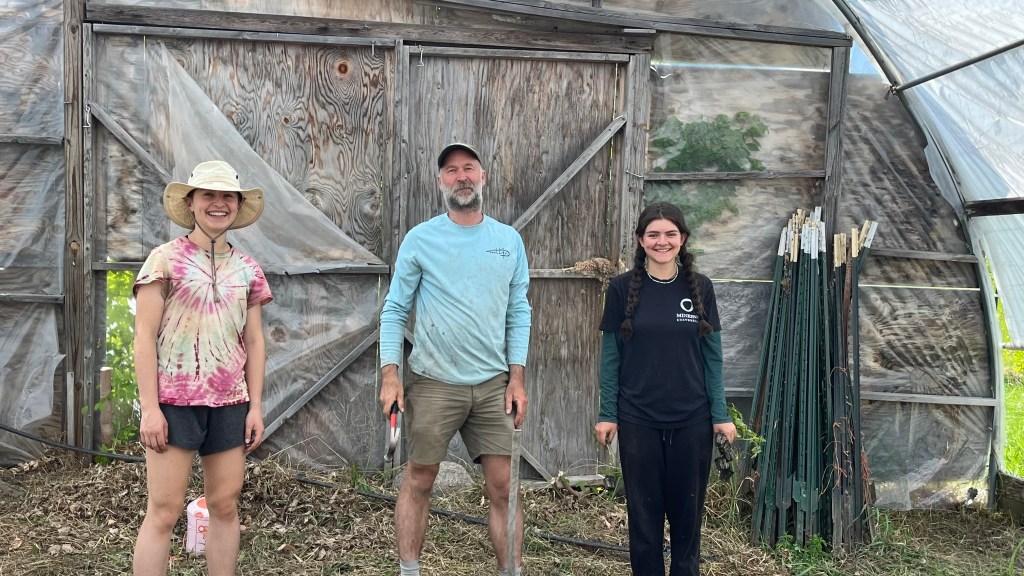
Our lives unfold each year with different color and energy and each farm season is no different with different weather, issues, and crew. For the beginning of the season, we had Gen Z Farm going on with the Sylvia and Camila show (both 20 years old) until Sylvia went to Ann Arbor to study biostats. With this much youthful labor we were keeping up on things even as the weather was throwing us some curveballs – 90 degree heat and dry in May, followed by 34 degrees and wet. Some crops were casualties, but others did awesome. All told, I’m feeling great about the state of the farm as of mid June.
We also try new things each year. This year I went deep into changing up the production system to permanent raised beds in our two oldest fields.

For the last 6-8 years we’ve been moving towards more intensive plantings of crops on smaller 30-inch beds in contrast to a typical 60-inch bed made with a tractor. Although the effort is great on the front end to built up these beds, the end result is beautiful. Each bed is easier to handle, really productive, and standardized so irrigation and covers planted really intensively and producing well. The big thing is we’re focusing our energy on these small intensive plots instead of a larger space and things are going well. I’m sure I’ll recap the experiment as we move through summer, but right now it’s looking good:

In the box:

  • 2 Bok Choy: We made a great rice noodle dish just a couple days ago which used bok choy. An example is at https://choosingchia.com/15-minute-sesame-ginger-noodles/ but I just made one up. Sautee the stalk together with an onion, add the leafy part after the onion and stalk soften just before the sauce (mix of rice wine vinegar, soy sauce, hot sauce, with a T of corn starch or a person could just use a pre-mixed sauce like Bachans). Top this over the prepared and drained noodles, mix, and serve.
  • Basil
  • Garlic Scapes: The bunch of long curly things. Wherever you would use fresh garlic, use scapes. They are a bit more mild than garlic cloves.
  • 2 Big Beets: These greens are about as good as beet greens get, so you can certainly put into a salad, smoothie, or saute
  • Green Leaf Lettuce: This is just straight-up lettuce – pretty delicate with good nutty flavor grown in the high tunnel.
  • Salad Mix: A mix of lettuce colors and varieties in the produce bag.
  • 2 Radish Bunches
  • Swiss Chard: The rhubarb-looking stuff for those of you not familiar with chard. Taste just like beet greens. One idea I do most mornings this time of year is to saute with those garlic scapes and top your morning eggs or fold into an omlette.
  • Kale: Standard curly variety called Winterbor. Can be used fresh or cooked.
  • Fresh Mint: Mojito anyone?
  • Fresh Terragon: Pairs nicely with chicken – think Mediterranean French cooking 🙂

It Took 20 Years

Wait, is the local food movement ‘normal’ now?

For a host of reasons, I became a farm apprentice in the year 2000 just north of the Twin Cities. You have to know that at the time, that was a pretty countercultural move. Instead of putting my new college degree to work and starting a career, I stepped into a world filled with dreamers, radicals, old hippies, and people into new age-y stuff from crystals to veganism to primal therapy. Like any young adult I had sought out something edgy, and, in doing so, found a community of really good-hearted and earnest people working to make the world a bit more caring toward other people and the planet.

America at the time (same as today) was racing towards more. More business, more money, more wealth, more development. The Twin Cities were growing fast and I thought that soon every acre of farmland was going to be made into one large strip mall. The solution? Let’s unplug from this fast-moving car a bit and at least change how we eat. Get off the well-worn path to the big box grocery where the only food on menu was cheap, laden with preservatives and pesticides, and mainly benefitted corporations – certainly not the farmers, animals, or the communities wrapped up in the agricultural supply chain.

I thought it was a compelling argument, but, at the time, who was listening? NOT MANY. The message came via messengers who were bunch of weirdos – idealistic college kids or back-to-the-land types who were knitting their own underwear or just smoked too much pot. Impractical idiots who convinced only some other impractical idiots who were already their friends. But, over time, it’s not the message or lifestyles of the messengers that mattered. It was the product. Good food is just good food and when customers got better tomatoes, they wanted more. Over time this little corner of the marketplace grew.

This past week I had a U of M dean in suit and tie tell me to keep up the good work of building local food businesses since it’s part of this larger movement. Man, the local food movement IS now normal. My reflection here at the end of the season is that, even though the movement may not be as countercultural as it once was, the world does seem to have caught up and that’s a good thing.

In the box – LAST ONE!

  • Butternut squash: Tan one
  • Pie Pumpkin
  • 2-3 Delicata Squash
  • Yellow Potatoes
  • Carrots
  • 2-3 Turnips
  • A few Shallots
  • Spinach
  • Garlic
  • Napa Cabbage
  • Fresh Rosemary
  • A couple Rutabagas

Abundance Sells

A long time ago, I stepped away from our farmers market stall towards the end of the market, looked back, and thought, I wouldn’t shop at that stand! On the table sat something like one last pint of cherry tomatoes, a bunch of radishes, and two misshapen cucumbers. It was a sad sight, but also explained the adage I learned from a wise greengrocer at Mississippi Market Co-op in St. Paul where I worked for three years, “People eat with their eyes.”

It’s so true. Even if the three items left over on a market table are good, it doesn’t matter. We as humans are attracted to abundance. Whether the piles of turmeric that caught our eyes when Mar and I visited the spice market in Istanbul or the two stories of toilet paper that reel customers into Costco all day long, the attraction is the same. It’s built into our DNA as mammals who scoured a world of scarcity for millennia to feed ourselves.

That’s why my most popular posts of all time are simply piles of produce. One of favorites from years ago was when my apprentice Sarah and I jammed my Honda Fit to the brim with red peppers like it was some kind of circus act. But pet plus abundance works, so does people plus abundance or pickups weighted down with so much squash that the suspension is strained – you get the idea.

In the box:

That’s a Winter Project

Do you ever say, “Looks like a good winter project?” This time of year I always seem to collect those, which isn’t much help to get myself through the work before me. The challenge, however, comes whenever you get to winter and those same projects become spring project or next year projects which at some point become never project. The intention of making it happen is still there, but you get the idea.

I’ve been walking around the farm lately and telling myself a good number times, “Boy, that would be good to get done.” The list so far has cut and transport firewood on hill (been sitting there 2 years), clear brush growing next to shed down the hill, fix Allis Chalmers G sitting in front field, fix Farmall H sitting at end of driveway, build packing shed lean-to, plus about 6 other things I see daily.

The expectation is that I’d feel great when I get the lingering project done, which is true, but I still have to DO IT. Oftentimes, the time I expected it to take isn’t even that great – relief from the burden of thinking about it may be as little as a few hours. My favorite example was filling the holes left in our stucco house from when we had insulation blown in the walls. We “temporarily” put a little foam there to cover the hole which my parents one day spray painted gray to match the stucco. Whenever I had some time, I just needed to putty some stucco into the holes. I thought about this for EIGHT YEARS. Every day I came home and thought, I should get to that. For EIGHT YEARS I ruminated, estimating it would take a whole weekend. One Saturday, I got the gumption to make it happen. Total time – 45 minutes! I totally felt better too.

Maybe this weekend we’ll all get to that list.

In the box:

  • Buttercup Squash
  • Carnival Sweet Dumpling Squash: I really like this variety. It’s a sweet version of an acorn, which has the texture I like. Check out this roasted recipe: https://heartbeetkitchen.com/roasted-sweet-dumpling-squash-with-brown-butter/
  • Salad Mix
  • Tomatoes
  • Italia Peppers
  • Colored Pepper
  • 1-2 Hakurai Salad Turnips: White radish-like things. Just peel outside off and eat them with a little salt. You can also slice into a salad (hence the name).
  • Green Cabbage
  • Kale
  • A Red and Sweet Onion

I Hit the Wall

With a couple notable exceptions, I get to a place in September before the first frost where my brain and body stop wanting to cooperate. Have you ever had this? They say life is a marathon, not a sprint. I agree. Each farm season is also more like a marathon than a sprint, but it doesn’t matter. When you’re on mile 20, your body is like “I don’t want to do this anymore,” and your mind agrees 🙂

Still, I’ve done this 20 years, and, although I may not have the energy of my 26-year-old self, I am wise enough to know that (1) it totally slows down when we get a frost, (2) three weeks go by much quicker than one realizes, and (3) my apprentice, Mason, does have the energy to power through. It certainly helps to have a partner in crime in the field. Also, after I deliver the last box, Maree and I are off on Amtrak to Montana and will be sitting in the hot springs in no time. It’s always good to put a carrot at the end of stick to motivate yourself!

Photo by Quinn Hot Springs, Paradise, MT

In the box:

  • Russet Potatoes
  • Slicing Tomatoes
  • Colored Peppers : Most are Italia pepper so a long variety (sweet, not hot). Should be sweet when mix of green and red.
  • A couple Jalapenos: Some are red, so check your pepper type before using – pretty easy to tell apart from the Italia Pepper (I hope)
  • Cantaloupe
  • Korean Melons: Small yellow melon with stripes. It’s a very crunchy melon, but great flavor – reminds me of an Asian pear
  • Carrots: Not the most beautiful carrots we’ve dug, but they are here. The root crops (carrots + beets) have not been doing well where we planted them this year.
  • A couple Delicata Squash: Yellow/white with green stripes. Easy done in the oven as half rings – https://www.rachelcooks.com/how-to-cook-delicata-squash/
  • Garlic
  • Red + Sweet Onion
  • Salad Mix
  • Cherry Tomatoes