Deep Winter Greenhouse Production

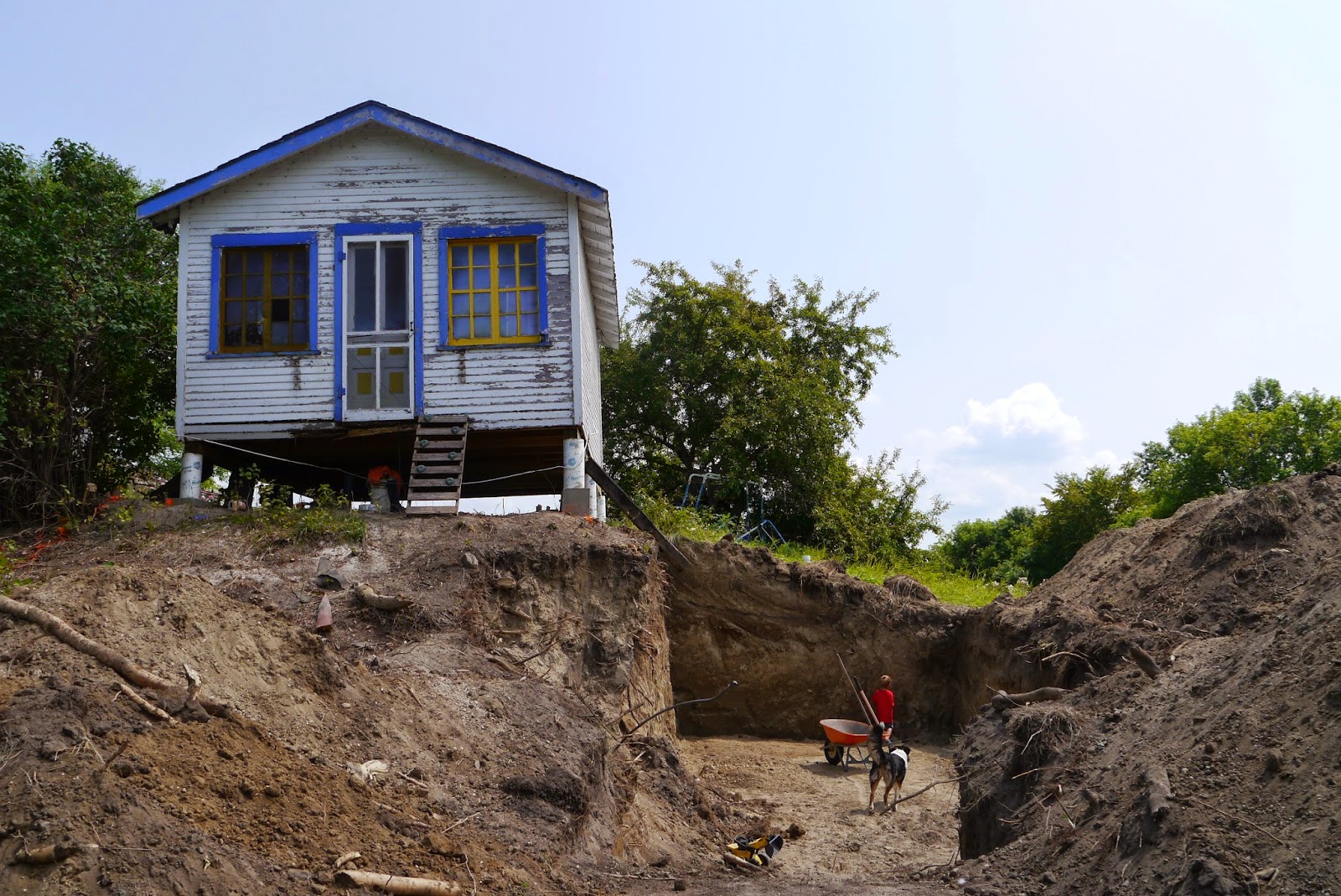
Site for greenhouse and cabin we recently moved for future interns

We at Lida Farm are currently in our 10th year of vegetable production here in Otter Tail County.  Like any organization which reaches such a milestone, we began to ask ourselves what’s next.  And, like many others who have been part of the local foods movement in the Upper Midwest, we’ve decided to extend our season to the extreme by building a deep winter greenhouse.  The idea is to build a structure which will allow us to grow some greens and crops which could do well not only is the cooler temperatures of winter, but the low light intensity as well.

Right now we have a really big hole in our backyard which is making us a bit nervous because it looks like a bigger project than we expected.  However, as soon as tomorrow we’ll start framing a structure which will hold 10-inches of insulation in the walls and sit 5-feet below grade to take advantage of the constant moderate temperatures of the earth at that depth.  In the five feet below the soil, we’ll have a network of tiling in rock and radiant floor tubing to keep the greenhouse above freezing, even through winters as nasty as the one we left behind in April.  Since we’re digging a big hole in the hillside near our house, we also decided to incorporate a small root cellar as well – why not, right?  Our major plans are to offer a limited number of winter and fall CSA shares to provide members greens and storage root crops during the time of year we really crave some good produce.  

In this week’s CSA box:
Sweet Corn: Hey, we made it!  It’s a mix of varieties, including Bodacious (Yellow) and Luscious (a bi-color variety from organic seed)
A mix of tomatoes:  These are just starting to turn as well, but boy are we happy they are starting up.
Japanese Eggplant: These guys taste just like a standard Italian one and you prepare the same way.
Basil
Sweet Onion
Pepper: Most received a purple variety called Islander which tastes like a green one.  Others got a light-green variety called Biscayne
Summer Squash: Most received green zucchini, but some received a yellow type.

Recipe: Our suggestion is to simply grill everything.  Easy.  Delicious.  You can’t go wrong.

The Week in-between the Seasons

I think of this week and the week in-between.  As I go out and scout the fields, I see a lot of tomatoes, but very few changing color.  I see many little eggplants, ears of corn not yet ripe or filled out, and peppers close, but not yet mature.  It always makes me both excited and anxious.  Excited for what’s close to mature, and anxious because I really want to fill the CSA box with all these wonderful crops.  Typically the week in-between comes earlier, but, here we are, still waiting for these high-season crops at a the beginning of August.  When we look at the forecast, it sure looks like we’re going to have some good growing weather with hot sunny days and nights in the 60’s.

In the box:
Green Onions
Bunch of Beets
Mini-head of Romaine
Parsley
Kohlrabi
A couple Cukes
Salad Turnip
A little tomato or a pepper (I found a whopping 10 ripe tomatoes out there today, so I thought you would appreciate a sample anyway – everybody else received a Biscayne or Islander pepper)
Red Torpedo Onion
Sweet Onion


Beating Back the Weeds

Last night, like many a night before, we continued with our battle against really big weeds.  This time of year, in good soil, weeds like redroot pigweed and lamb’s quarters turn into small trees with roots 6

Our Tine Weeder

inches in the ground.  When I should be looking over our onion field with row after row of beautifully-spaced and maturing white bulbs, I instead see a forest of green going to seed.  We got to this place this year from a wet spring which continued into early summer.  Oftentimes people think the major issue with lots of rain is that it sets back planting, but, on an organic farm like ours, the biggest challenge with a long, wet season is the inability to control weeds.  We use mechanical cultivation to take out weeds when they are just emerging.  Our cultivation equipment consists of an old Farmall H with shovels attached and a tine weeder which drags over the bed.  When not even able to walk on the totally saturated soils in June, we sure were not able to drive a tractor out there, and, once a full flush of weeds germinated at got to a good size, tractor cultivation doesn’t do a great job of killing them.  So, it’s come down to us, a lot of time, and our hands.  After a few weeks, I feel we are starting to win this war of attrition as we reclaim territory row by row.  It certainly is a great sight when I get to the end of a bed and can look back over the uncovered plants – ah, relief!  Recently rescued crops include the second planting of beans and a pretty bed of carrots.  

It was nice to see some members last week who came out picking peas.   But I know a lot of members still haven’t been out.  Please know you are welcome and I’d be happy to show you the sights.  Got kids, maybe they’d like to see the pigs or give Peanut, the milk cow, a leaf of hay?  If you are in the neighborhood, stop on by.  Sunday’s are typically good as we are almost always around.  
I hope you’ve been enjoying the “early season” veggies (hard to believe I’m saying that at the end of July).  I saw some cherry tomatoes turning in the high tunnel a couple days ago and melons starting to swell on the vine.  Over the next couple of week, expect to start making a transition to high season as corn, tomatoes, and peppers begin to ripen.

In the box: 
Cilantro 
Dill 
Red or Green Leaf Lettuce
Dino Kale 
Cucumbers 
Green Beans: Most of these are a variety called Grenoble I really like because of their dark color and waxy texture.
Pattypan or Staightneck Summer Sqaush
Sweet Onion: A variety called Ailsa Craig
Simple Cucumber Salad
Simply in Season (page 100)
So many of us (myself included) always reach for vinegar and salt when preparing cucumbers for the table, but, with so many now coming in, here’s a creamy version which will use a few things from the box
3 cups cucumbers, thinly sliced 
1/2 cup sweet onion, thinly sliced 
3/4 cup plain yogurt
1-2 tablespoons fresh dill weed (chopped)
Place cucumbers and onion in a large bowl and sprinkle with 1 teaspoon salt.  Let stand one hour.  Drain.  Add yogurt and dill and serve. 

A 4-H Family Tradition

Sylvia’s champion produce arrangement

When our daughter, Sylvia, was asking about what to bring to the fair, our obvious answer was “vegetables.”  Being that this is the first year she could show and place (she graduated from Cloverbuds), it took us a bit to figure out exactly how to present the veggies for the fair.  We read through this publication Extension put together back in the 70’s – an oldie, but goodie, I guess.  Then, Tuesday morning, we trounced out to the garden to pull in a assortment consisting of a cabbage, peas, cucumbers, beets, swiss chard, and summer squash.  Maree and Sylvia must have a good eye because she was awarded champion at the West Otter Tail County Fair.

One neat thing about the kids now getting into 4-H and the fair is that they are picking up on a long family tradition started with Maree’s great-grandfather, Charles Goetschel.  Settling in Lake Elmo in the 1840’s, Maree’s family operated a diversified dairy operation up until early 2000’s; I always say Maree grew up at the last remaining dairy farm in Lake Elmo, although I really don’t know if that’s true.  Apparently these guys were fierce competition at both the Washington County Fair and the State Fair, especially in field crops.  Maree’s mom passed on this little clipping from the 30’s about her grandpa Wally in his last year of 4-H.  
In the CSA box: 
Napa Cabbage
Bok Choi
Green Beans 
Summer Squash: Yellow and zucchini
Cucumbers
Swiss Chard: Colorful green with a blue band
‘Imperial’ broccoli
Bunch of Cilantro: One with a red band around it.  
Fennel: This one seems to freak people out, but there’s a recipe below
Green Bean and Fennel Salad with Shaved Parmesan 
  1. 1 pound green beans
  2. 1/4 cup extra-virgin olive oil
  3. 2 tablespoons fresh lemon juice
  4. Salt and freshly ground pepper
  5. 2 small fennel bulbs (about 1 pound)
  6. 2/3 cup shaved Parmesan cheese (about 3 ounces)
  1. Cook the beans in a large saucepan of boiling salted water until nearly tender, about 6 minutes. Drain them in a colander and refresh under cold running water. Drain well.
  2. In a medium bowl, combine the olive oil and lemon juice and season with salt and pepper. Thinly slice the fennel lengthwise, add it to the bowl and toss, then transfer the fennel to a platter. Add the beans to the bowl and toss with the remaining dressing, then transfer them to the platter. Garnish with the Parmesan shavings and serve.

Lida Farm now accepting SNAP benefits

In order to local foods more accessible to more people, there has been a lot of effort over the last few years for farmers markets to accept SNAP benefits (formerly known as food stamps) through EBT (Electronic Benefits Transfer…folks get a card like a credit card).  Our own farmers market in Detroit Lakes got authorized to accept SNAP  about 4 years ago.  It was not a great success.  We tried again last year, but the vendors chose not to pursue it again for this year.  Many felt we were not reaching enough people for all the logistics and effort involved – dealing with credit card companies and the wireless terminal technology does take some effort, much less communicating the program to all vendors at a time of year when everybody’s under the stress of the farm season.  

I’ve always felt that good local food should be accessible to everybody.  Too often the only people at farmers markets or signing up for a CSA have graduate degrees and drive a Subaru or Volkswagen (things which also characterize myself).  So, recently we authorized Lida Farm itself to accept SNAP benefits and got enrolled in a program called Marketlink, funded through the USDA.  Since we were the only vendor authorized at our farmers market, we qualified and now have a iPhone with a card reader and even a wireless printer for receipts – pretty slick.  We will be able to start accepting SNAP at the Lakes Area Farmers Market in DL on Saturdays and also accept SNAP for CSA payments.

For CSA members we’ll be open Sunday for a Pea Pick.  If you would like to pick some more peas, please come on out to the farm anytime from 9 am to dusk.

In the CSA box:

  • Green Cabbage
  • Kohlrabi
  • Snap Peas 
  • Radishes 
  • Salad Mix
  • Beets
  • Summer Squash: Most got a yellow summer squash and a zucchini.  You’d use the yellow the same as the green 
  • Cucumbers
Summer Squash Fritters
I’m really into these for breakfast.   They are good topped with some sauteed greens and green onions if you still have some around from a previous box.  
2 eggs 
2-3 summer squash 
Salt and pepper
T oil
Grate the summer squash like hashbrowns into a bowl.  Crack in a couple eggs, mix with a fork. Season with salt and pepper.  Heat up the oil in a skillet at medium-low heat.  Pour in the fritter mix and fry til firm and browned a bit underneath.  Flip and brown the other side.  Top with salsa, sour cream, whatever you like.