Corn Harvest (CSA Week 8)

Things really get crazy for us this time of year. This is the time when I either get reinvigorated by all the great produce which is coming in or I “hit the wall.” I don’t know which way I’m going to go this year, but I appreciate all the things which are finally coming in. This is the first week of tomatoes-albeit only cherry tomatoes and small yellows-as well as good-sized carrots, peppers, and sweet corn. Man, that’s exciting…sweet corn. I’ve only had people asking about sweet corn at the farmers market for about 6 weeks (people get impatient and I run out of excuses), so now it’s finally here.

I have a real love-hate relationship with picking sweet corn. What I love about it is that it’s the first thing I do when I go out to get ready for the CSA or market. This is that time of the morning when I’m all by myself and it’s really peaceful out. Still, I like the action of grasping, pulling, and twisting off cobs in one motion…something really feels good about it. Unlike other crops, corn is really satisfying because you go from an empty crate to a full one in about 15 minutes instead of something like beans where you feel like you’re filling up a mason jar one grain of sand at a time. This is why I have Maree pick all those things 🙂 Like the yellow beans in the box this week and last week…as you see from the picture Mar is trying her hand at pickling them this week. My patience is only so good.
On the other hand, picking corn first thing in the morning can be a cold, wet ordeal. If any of you had to do this, you know what I’m talking about. First thing in the morning, the dew is really heavy, and, instead of sitting in the comfort of home, drinking a cup of coffee and reading the paper, you’re outside wresting 6-foot tall corn plants, getting your clothes soaked through, and getting these little cuts on your arms from the leaves.
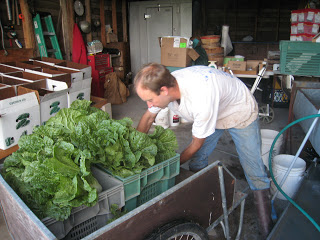
All told, I like it more than dislike it. Even when I’m not in the mood, I still like to step back and admire the harvest in the packing shed over some coffee. It just feels good.
In the box:
Sweet corn: There is a mix of two early varieties. The bi-color (white and yellow) is called Native Gem and the all-yellow is called Spring Treat (far from spring, but Mid-August treat just doesn’t sound as good).
Yellow Wax Beans
Flat Italian Beans
Kohlrabi
Red Onion
Carrots: A variety called Little Finger…a fresh eating variety which should not be too big.
A couple cucumbers
Tomato sampler: Some cherries (one variety called sungold is supposed to be orange), a grape if you’re lucky, a couple yellow Taxi, and a few Julia roma tomatoes. Not many, but a start
Some peas: a mix of snow and snap peas, so the pods of each are edible…so don’t try to shell.

Gourmet | August 2009

by Maggie Ruggiero

Sure, go ahead and cook your favorite sausages, but be sure to use every iota of their flavor: Reheat the skillet and work some pork-based magic on a seasonal array of onion, fennel, tomatoes, and corn.

Yield: Makes 4 servings
Active Time: 20 min
Total Time: 35 min

ingredients

4 (5-to 6-ounces) fresh pork sausages
1/3 cup water
3/4 cup chopped sweet onion
1 medium fennel bulb, chopped
1 cup grape tomatoes (5 oz)
2 ears corn, kernels cut from cob
1/4 cup coarsely chopped dill

preparation

Prick sausages a few times. Simmer with water in a 12-inch heavy skillet, covered, over medium heat 7 minutes. Uncover and cook, turning occasionally, until water has evaporated and sausages are well browned and cooked through, 7 to 10 minutes more. (You may need to add 1 tablespoon oil to skillet, depending on sausages.) Transfer sausages to a plate and pour off all but 1 tablespoon fat from skillet if necessary.

Cook onion, fennel, and tomatoes with 1/2 teaspoon salt and 1/4 teaspoon pepper in skillet over medium heat, stirring and scraping up brown bits, until onion and fennel are crisp-tender and tomatoes are soft and beginning to burst, about 7 minutes. Add corn and dill and sauté 2 minutes.

Slice sausages and serve with vegetables.

I figured this would be good if you’re still holding onto some fennel from last week.

Send Heat, Please (CSA week 7)

Well, another week gone by and another week of way-too-cold temperatures. I thought this summer would be “normal” after last summer, but it may just be weirder than last.
So, how big of an affect is this on the produce? Well, the biggest issue is getting those warm season crops to market and in the box. One example is that our earliest corn, a 58 day sweet corn (that is, 58 growing days from emergence to ripe corn) is still not ready and it was planted in mid May. I’m sure that’s going to make it since all we need are the kernals to fill out, but what about the late season corn which is 78 days? What about that popcorn I’m trying this year at 90 days? Yikes! Warm season crops just grow so slow when we only hit 75 during the day and the plants completely shut down when we hit 50 degrees at night. Those nights when you can’t sleep because it’s too hot and muggy are what we need because then things are growing even then…we haven’t had a single night like that.
I’m certain we’ll get these warm-season crops to come in, but the season will be pretty short. We’ll have an avalanche of stuff at the end of August til Mid-September, which is good, but I’d rather the stuff be in now until Mid-September.

In the box:

One Japanese Eggplant
Cucumbers
Parsley
One Garlic…fresh, so a bit different to peel.
Zucchini
Sweet Onion-a big variety called Alisa Craig
Torpedo Onion
Yellow Beans
Beets
Broccoli
Baby Red Potatoes
A Baby Bok Choi
More raspberries: we’re making the rounds…definately need to plant more so we’re not scrounging and can supply everybody for a couple weeks.
2 Cucumber Salads
3 cups cucumbers (thinly sliced)
1/2 cup onion (thinly sliced)
Salad 1:
Place cucumbers and onions in a large bowl and sprinkle with 1 tsp. salt. Let stand 1 hour; drain.
1/3 cup sugar
1/4 cup vinegar
1/2 tsp. celery seed
Mix together in a saucepan. Bring to a boil, cook and stir until sugar is dissolved. Pour over cucumbers. Cover and marinate in refrigerator for several hours or overnight. Keeps several days.
Salad 2:
1/4 cup vinegar or lemon juice
2 T. oil
1/2 t. salt
1 T. sugar (optional)
Mix together and add to the cucumbers and onions.

Packing Produce (CSA week 3)

Well, things are finally starting to grow. Since it’s been so warm lately, I forget how cold it was earlier in the year, and I wonder why things aren’t ready for harvest. But those days in May and early June make a real differencel on when things are ready. But I’m thankful for the warmth…it allows us to watch those warm-season crops take off and finish off the cold season ones (like the spinich which made it in the box before it “bolted” or went to seed). I’m also thankful for the mild rain we had yesterday instead of the “monster storm” we were supposed to get. I feel that we’ve already had our hail for the year and don’t want another round.

One new development for the year is our new packing shed where we bring in all the produce to be washed and packed in boxes. The shed isn’t exactly new, but we converted our machine shed for the purpose. Up til now, we’ve used the greenhouse, which isn’t optimal for a number of reasons. One being that it’s just a dirt floor and after sloshing around water for a while, I always find myself in a big mud puddle….the heat of the greenhouse didn’t help either!
The set up of the packing shed is pretty important. It’s kind of like a little manufacturing plant…produce comes in, goes through a couple stations and finished CSA boxes go out. I have it set up with all the washing tubs on one side and the tables which hold the boxes on the other. We have a whole bank of tubs and sinks so that we can soak a different crop in each tub for a while, since it’s really important to hydrocool produce for a good half-hour to take out the field heat. If we didn’t do this, the produce would look good when you first get it and then mysteriously go bad in a couple days. In the back is our walk-in cooler–out of the way–where things can be held over for a while. I even just got a set of roollers (kind of like a conveyor belt with rollers) which we’ll be settting up to lessen the time we spend shifting crates of produce around…when the boxes are done, we’ll be able to just count them off and push them down the rollers to the van instead of take two at a time, walking back and forth from the van.
In the box:
Napa Cabbage (see recipe): the recipe is for a cold slaw, but napa is a traditional stir-fry stand by. I like cooked more myself.
Pint o’strawberries
Summer squash (some zucchini and some yellow pattypans)
Kohlrabi
Cilantro (wish I had some tomatoes to go with this!)
Braising Mix: this is a mix of young greens which can be sauteed on their own with some onions or garlic or added a stir fry at the very end. Just chop and fry.
Red Oaklead Lettuce: one of my favorites…it’s pretty and has a nice nutty flavor.
Romaine Lettuce
Spinich

  • 1/4 cup rice vinegar (not seasoned)
  • 2 teaspoons sugar
  • 1 teaspoon grated peeled ginger
  • 2 tablespoons vegetable oil
  • 1 fresh serrano chile, finely chopped, with seeds
  • 1 small head Napa cabbage (1 1/2 pounds), cored and cut crosswise into 1/2-inch slices
  • 1 bunch scallions, sliced
  • 1/2 cup coarsely chopped cilantro


Whisk together vinegar, sugar, ginger, oil, chile, and 1/2 teaspoon salt. Add remaining ingredients and toss well. Let stand, tossing occasionally, 10 minutes.

The Art of Cultivation (CSA week 2)


If you grow organically, you have to learn to cultivate and there’s a lot to it…hence the art. The term is used pretty generally nowadays to mean “grow” or “nurture” things as in “Target has been cultivating customers through their new marketing plan…” Stuff like that. But in farming cultivation means something quite specific: breaking up the ground with a cultivator to kill weeds. I cultivate in a couple of different ways. One is what’s called “blind cultivation”, where you drag a cultivator right over the top of the bed, including the plants. I do this with our new contraption of the year, a Williams Tool System, which is a kind of tine weeder. I always feel like I’m going to kill all the plants, but the tines are designed to put on enough pressure to take out the little weeds, but leave the rooted plants. It has done great work and things like the corn, onions, and potatoes havn’t looked this weed-free before. The other way we cultivate is with a traditional two-row cultivator, which has these shovels and knives on either side of the row to take out anything between the plants.

This sounds pretty straightforward, but a grower needs to keep a fine eye to details to cultivate well, and, frankly, I’m not that great at it. The timing has to be right (best when a lot of weed seeds have germinated, but still just seedlings), the soil moisture good (too wet and you get clods to last the summer), the shanks and shovels have to be digging at the right depth (not too deep, not too shallow), and all the while you have to run the tractor as straight as the rows you planted in the spring or you take out half the row. So far, so good this year.
When I got to thinking about cultivating, it made me think about a conversation I had with my neighbor Marvin last year. Since he’s farmed all his life, I asked him about how many farmers still cultivate and he figured about 5% since life with chemicals is so much easier…instead of cultivating 3-4 times, you can spray twice and kill off every single weed. I thought that was kind of low, but as I was driving around last year I saw only one person other than Marvin and myself cultivating a field! Keep you eye’s peeled…you may still see some out there.
Weather report….hail last saturday, but not terrible. You will probably see some holes in the lettuce, but I promise it will taste the same.
In the box:
Fresh Basil
Kohlrabi: simply peel, cut, and serve…some recipes call for the greens.
Arugula: can mix in with lettuce for salad or find pasta recipe
Red Sails Lettuce
Green Leaf Lettuce
Garlic Scapes: the tops a garlic plant will send up…like a garlicy green onion. Chop fine, sautee a bit, and throw in mashed potatoes.
Quart o’ Strawberries
Some radishes
Red Russian Kale
Kale Colcannon
St. Paul Farmers Market Produce Cookbook
5 med. potatoes, peeled and quartered 1/3 cup lowfat milk
4-6 cups kale, with stems removed, washed and chopped 1 t. salt, or to taste
2 T. butter or margarine 1/8 t. black pepper
1 small onion, chopped
Boil potatoes until tender. Steam kale separately until tender, about 10 minutes. While potatoes and kale are cooking, heat butter or margarine in a large pot. Saute onion until soft. Mash potatoes, add kale, onion, milk, salt, and pepper. Mix well. Reheat and adjust seasonings.
Makes 4-6 servings.

The Good, Bad, and Ugly of 2008

As we approach the end of the season, we start playing the good/bad crop game. When you’re cleaning up a bed of one crop at the end of the year, you can’t help but judge how the year went. So, kind of like the Oscars for vegetables, we have the good, the bad, and the ugly for the year.

The Good:
• Peppers: Hey I was just in the entryway where we have a few bushels of peppers and I can still smell them…great. Now that a number are turning colors, these clearly go into the good category. Not only did we have a lot, but they were a good size too…last year the Italias looked like big jalapelos or something.
• Salad mix: I’m finally getting the hand of growing this stuff well. We should have had a second planting for mid-season, but the stuff we put in the box looked great.
• Spring brassicas: this is the cabbage, broccoli, kohlrabi, and cauliflower at the beginning of the season. The cool wet spring worked well for these crops. What was most impressive is how long the spring bassica season lasted…you probably got sick of broccoli or cabbage at some point there!
• Tomatoes: a surprise here. Although it has taken forever for them to ripen, the plants set a lot of fruit and they look in good shape.

The Bad:
• Garlic: A real disappointment because I just go crazy for a good garlic crop. These plants do not grow well in a mud puddle like they had to this season.
• Green onions: This is in the bad category because it was the crop that never happened…do you ever remember getting green onions? They got planted first thing in the spring but that entire patch got overrun with weeds and I never got another succession planted—you can also put cilantro in this camp too.
• Head lettuce: After last season when we had a bumper crop, the lettuce was worthless. The window of lettuce was short and a lot bolted before it came of size.

The Ugly:
• Melons: There’s been a whole lot of ugliness here. The main factor is all of those cucumber beetles, who attack the plants and kill them off mid-season and then chew up the fruit if it starts to grow. Ugly.
• Second set of cucumbers: in part due to those pesky cucumber beetles and the new ground, this second planting put on nothing but deformed cukes. The timing was right to take over when the first planting pettered out, but they were too ugly to use.

All told, I can’t complain too much about the season. The weather was funny, but things still got produced and I know we improved on last year overall even if some crops did worse. Since you have to be optimistic in this line of work, what we do is ask ourselves how we can improve for next year.