The Power Playlist

I’m always telling people that growing produce commercially is simply a head game. Success has everything to do with one’s ability to stay on task and charge throught the many small jobs that make up a day-in-the-life of a produce farmer. No single task takes a lot of time or is really that difficult, but I need to pound through dozens and dozens of items a day just to stay even and not drown in a tidal wave of weeds and substandard crops.

ec339-earbudsThis is where the power playlist comes in. After I woke up yesterday, I did my usual routine – water, yoga, coffee – good combination right? Feeling sluggish and a bit overwhelmed, I was inspired to make a playlist in Apple Music I aptly named ‘Kicking Butt.’ I recalled my playlist of about 6 years ago of the same name and remembered some solid days of making things happen on the farm. I told myself, yes, this is the medicine you need right now, Ryan.

So, I started downloading songs and albums like crazy – The Who, MGMT, Stringsteen, even the Bellamy Brothers. I found power ballads, super-charged electronica, and even some hiphop. After a good hour of tinkering, I set out to give it a try.

Armed with my DeWitt Hoe, I hit play and the end of a row of weedy winter squash as Anderson Paak’s ‘Come Down’ hit my ears with the world’s best bassline for a warm up. Next, came Nivarna’s ‘Smells Like Teen Spirit’ at 8 in the morning, followed by ‘Angel from Montgomery,’ ‘Let Your Love Flow,’ and ‘Rock the Casbah.’ Running the risk of sounding like the Time Life infomercial, the hits just kept on coming: Lisztomania, Paper Planes, Barb O’Riley, Atlantic City (The Band version), Beast of Burden, Maggie May, Timber, and Like a Rolling Stone.

Out of breath and sweating in the humid July heat, I wondered why people buy gym memberships. An Apple Music subscription and a $40 hoe and a person can actually make money 🙂 I’d say the list needs a little fine tuning over the season – I’ll work on the abrupt transitions from a Rolling Stones number to ‘Blurred Lines’ but we have a good start.

In the box:

  • Snap Peas: Don’t shell these things – edible pod.
  • Radishes
  • Cucumbers
  • Zucchini
  • A few garlic scapes
  • Westlander Kale
  • Green Leaf lettuce or salad mix

A Restart

Up to the start of this season, I’ve been in a funk. Understandable, right? The world is one big mess and my heart wasn’t engaged. I was plodding along – some good days farming, some worthless days. The farm and my mind reflected our collective messy moment.

Barn and Turbine 2020Yesterday, however, something turned. I was 100% in the moment. We cleaned tubs and the packing shed. We set up boxes. I had this feeling that we were restarting. Despite all that had brought us to this place, as I was standing on the newly washed floor by the stainless steel dairy sinks, the world started anew.
This is the magic of a farming. Life starts over. New plants, new landscape, new season. At the farm we have the pleasure of reconstructing something new and it doesn’t entail us doing demolition or tedious legal manuvers. This is just how it’s done. As it’s been done for millenia. It must be this process that makes us farm operators optimists.

It may have taken me a while to get there, but, for me, this year especially, I have found a new hope. I never promise members that everything will be perfect and a season will go off without a hitch, but I do promise that we will do out utmost to work our little corner of the world. After all, that’s all we can ask of ourselves or any of us. Peace.

In the box:

  • Swiss Chard: Video below gives you an idea on how to prepare – you can substitute out the garlic for the garlic scapes.
  • Garlic Scapes: These are the little shoots that come up out of hardneck garlic – very short season crop – milder than garlic itself, feel free to substitute whereever you use garlic. You can dice the whole stalk.
  • Radishes
  • Arugula
  • Zucchini
  • Basil

Invest Local!

As a young man, I learned the craft of vegetable production. I also developed my point of view from the conversations in the field.

Young Ryan
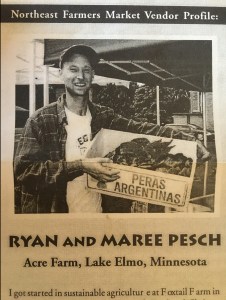
Young Ryan as Vendor at First Farmers Market

Sitting on my knees and propped up on my Red Wing boots in a bed of radishes, I’d engage in conversation with my farm mentors and fellow apprentices, all the while pulling out and banding the pink-red orbs without thinking. Our talk could be light and cheery or simply perfunctory, but we often landed on conversation about the meaning of our work and our lives.

We would bandy about the phrase ‘alternative local economy’ because we felt that operations like ours were creating an alternative for people to buy into, an economy based on cooperation between farms, businesses, and people for the benefit of all.  A type of business model where people and the land were more important than profits. Our outlook stood in stark contrast to the mainstream economy, which, at that time, produced the era of suburban sprawl, corporate downsizing, and a whole lot of strip malls. Main Street businesses were folding and Americans were flocking to big boxes on the edge of town for cheap goods and convenient parking.

We felt like a band of Don Quixotes tilting at the windmills of American Capitalism. But we didn’t care that we were out of step. Our work felt good and tangible and human. This was before the soccer moms of America discovered organic food and we were part of an underground community that was quite small and quirky, but, at the same time, motivated and generous. This start of good food movement that would soon burst out of the small clusters of 1970’s holdouts who hung around small food co-ops in the Twin Cities.

Today I’m 43. It’s been 20 years since I was sitting in Paul and Chris Burkhouse’s field picking radishes. I still believe that organic farming can save the world. I’m still adamant that if Americans refocus on building strong local economies and strong local communities, we will create the world we imagined. One where we are again neighbors, not simply consumers. Where independent businesses together build strong local supply chains that can withstand disruptions and create wealth for local communities.

Right now I know that we’re all shaken up by this pandemic and we’re worried about the future, but I also believe that recent events have given us many people an appetite to support an alternative future. 

I never directly solicit people on this blog, but now is not the time for polite rules of etiquette. If you’ve had enough of turning your attention and investments to Wall Street and expecting different outcomes, please join me and invest directly in MANNA Food Co-op at https://mannafoodcoop.com/capital/. 

We are right now raising investments and accepting charitable contributions to relocate and expand to downtown Detroit Lakes. You can directly invest in this independent business through preferred shares at $500 per share and memberships for $150 for a lifetime. We will certainly not get there without wide support of existing and new members, so please learn more, contribute, and share the opportunity with others, directing them to https://mannafoodcoop.com/capital/

Adopting Tools for the Season

Even in the dead of winter, sleeping farms like ours still have work to do. Some of that work is planning out the season-picking out seeds and perusing new tools-but some of it is fighting the elements of winter. I have to admit, like mowing grass in the summer, that I’m a lazy snow shoveler. Last month, after allowing a drift to grow with every flurry and wind gust, the whole family was walking up this 3-foot high incline and back down every time we wanted to get to our front door. After walking on it for a couple of weeks combined with a couple freeze-thaw cycles, the drift became a mini glacier on our sidewalk, impenetrable to all snow shovels. My strike of genius – maybe my greatest of all time – was to rescue the broadfork (typically used for breaking up soil) from our packing shed and pry apart the drift as if I were digging up carrots. One of those true dad ‘eureka’ moments. 

broadfork and snow

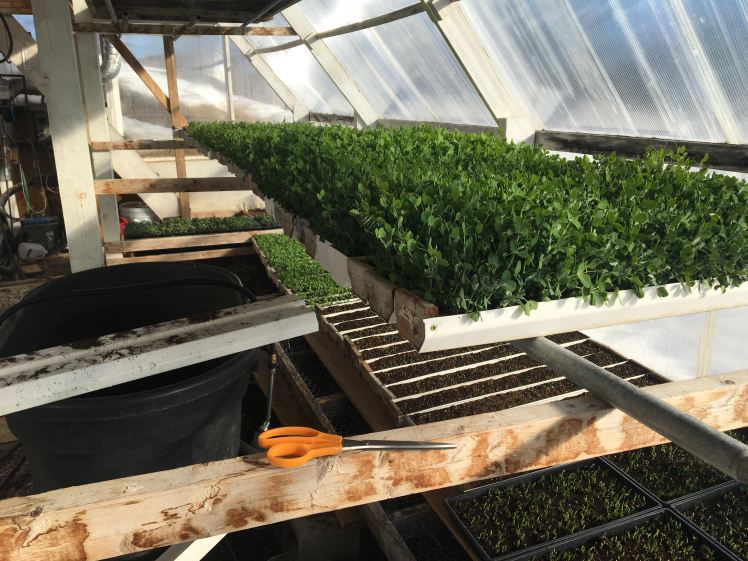
But enough of winter. We’re putting that behind us, right? This time of year pulls me deep into the most important of tools to adapt to the season – the winter greenhouse. Even though we’ve been growing greens in there since the beginning of the year for the Winter CSA, the summer season now begins its slow march forward. Onions and slow-growing herbs were seeded a month ago already, but just yesterday I laid down over 2,000 pepper seeds in trays. They are now safe and sound on a heating mat, working on germination. Today I plan to plant tomatoes for the high tunnels. After they pop, it will be just 6 weeks before they are in the soil – hard to believe. Man, I’ve got to get going!

winter pea shootsP.S. Yes, it is the season for CSA sign up. I am sitting on a bunch of stuffed envelopes addressed to members last year which will get out tomorrow, but a person could also download the order form here. 
A New Ending

Man, another final box, another end to a season. I had this experience now for 15 years and I find that each year has it’s own flavor. I’ve had years where I’m still energized and not ready for the season to end and I’ve had years where we barely made it over the finish line due to exhaustion.

This year, right now as I sit here, I’m not catching the same end-of-season relief. This darn rain has made our final fieldwork very difficult. I’m not looking forward to fighting mud. Also, have you ever had that feeling that you bit off more than you could chew? If you know me, I have the tendency to over-commit and I’ve painted myself into a new corner with my many jobs I try to manage.

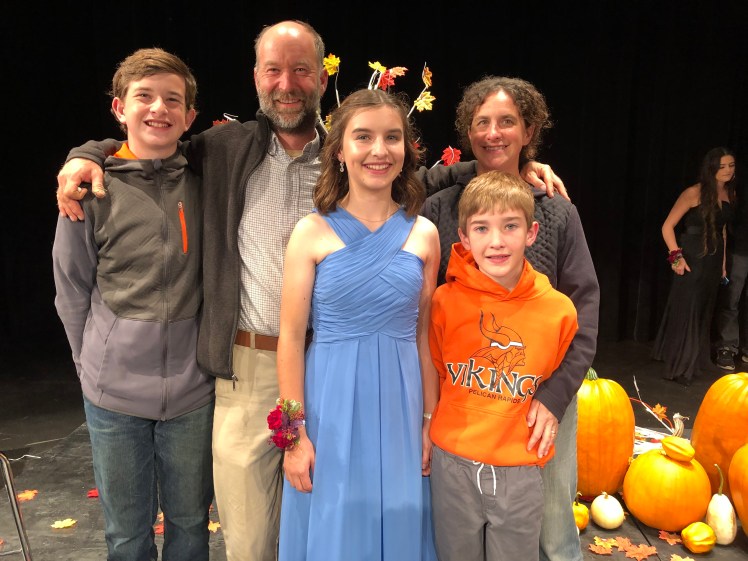
Family at homecomingI’ve learned that projecting too much into the future causes anxiety, and, at times like these, a simple reflection on the season as a whole balances me out. We had some great accomplishments and a lot of things went right:

  • Even though a couple crops were total duds (what happened to you, celery?), vegetable production was mostly good. We had our highest tomato yield ever.
  • We had a successful Kickstarter campaign to fund the Farm Stand at Manna Food Co-op and I started Friday markets there.
  • A crazy number of people discovered the farm stand at the end of the driveway this summer.
  • Wonderful members and customers. Every week I’ve had members and other customers voice their thanks and appreciation for the work we do.  We can rest assured that our daily activities produce something good on this earth and our work matters to others. I find this very meaningful.
  • Great partners. I have the pleasure of working with and knowing many other people who are trying to make the world better through good food and helping others find wellness in their lives by giving their time and energy. A shout out to my fellow board members, staff, involved member-owners at Manna Co-op, fellow members of our Sustainable Farming Association chapter, and enthusiasts of the good food movement across some of the many food-related initiatives I’ve been involved in.

So, yes, we still have challenges to take on in the near future, but the heart all of you have for this work and our operation makes me feel so grateful and we’re lucky to know and engage with every one of you. 

In the box:

  • Butternut Squash
  • Buttercup Squash
  • Long Pie Pumpkin: I added a little video to get your going on doing pie pumpkins from scratch. Mar and I stumbled upon this pie pumpkin some time ago and are big fans of is taste and texture.
  • Carrots 
  • Salad Mix or Spinach: (Farmers Choice)
  • Black Spanish Radishes: These seem like crazy things, I know, but most peel them before slicing.
  • Yellow and Red Onion
  • Mix of Peppers
  • Cilantro
  • Bunch of Kale
  • Head of Garlic