Farming with Children

People are used to seeing us spend most of our time running after our kids: Sylvia, 3; and Willem, 1. At this age, all you are doing is damage control, especially with the boy, stopping them from doing things like running in the street and destroying property. So, when people learn that we farm produce besides my day job, the usual reaction is “How do you do it?” We wonder this ourselves sometimes too, but, really, it comes down to some serious time management.

One thing we’ve learned is that we have to specialize our labor. We’ve tried working at the same time, hoping that the kids will just stick around, but it typically ends up a disaster. Something like digging potatoes or picking weeds holds a kid’s attention an average of 1-2 minutes; after that, they move onto bigger and better things. So, when we try this, one of us is always chasing after kids and we end up arguing over whose turn it is to catch them before they get hurt or trample a whole crop. Now we trade off a lot. One watches the kids and the other concentrates on farm work. Yesterday I took the kids for a 2-hour bike ride to the lake and Mar did some serious bean picking.

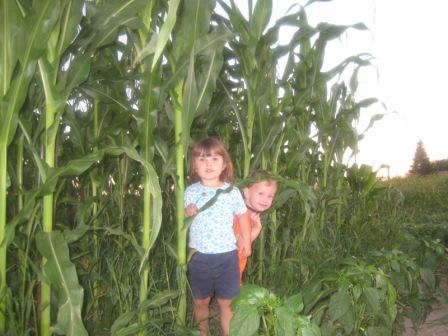
The great part of farming with children is watching them grow up with the farm. Sylvia knew the word “kohlrabi” at a very young age and Will THINKS he’s ready to drive a tractor. I read an article recently by an author named Gene Logsdon in Farming magazine about all the toys farm kids enjoy that you can’t buy in stores: everything from ponds to rocks and bugs. It made me think about the kids’ favorite toy of late: corn. For the past couple of weeks they keep asking us to go ‘play corn’ where they run up and down the corn rows screaming and trying to surprise one another and me. It’s pretty cool that we have four corn patches, so when they get bored with one area, they can move onto another. For me, as a parent, I just love it and I often think about the memories we make for our children. I have great memories of gardening at our plot near the sugar plant in East Grand Forks, wondering off looking for fox along the rail lines or harvesting corn with my family up by Warren, MN. And I grow concerned for those who will only have memories of Playstation, TV, and chatrooms…I’m concerned for their person and I’m concerned for a world where we have no real connection to land and family and community.

Soil Matters

I’m sure as I write you that each one of you have a slightly different soil in your backyard. Yours may be a bit sandy, good black loam, or a yellow clay. A grower has drastically different experiences depending on that soil type. At the farm, our soil is a pretty heavy clay. This has its advantages and its disadvantages. The major advantage is that it seriously retains moisture. For
example, last year when it was extremely dry after June, we didn’t have to set up irrigation until the end of July. Places with sandy soils like near Erhard and Dent had crops simply burn up. The couple disadvantages are compaction and soil
temperature. Both of these issues have been challenges this year since we’ve had the “monsoon season” most of the summer. As I’m sure your own plants did, many crops just sat in the mud not growing at all because of the low soil temperature as well as the retention of moisture. With so much water, plants were turning yellow because they simply weren’t getting oxygen due to saturated ground and not functioning to their best abilities because of the low temperatures. Compaction is the other issue which I think we’ve been skirting to the best of our abilities. The trick here with a clay soil is to use machinery only when the ground is pretty dry, if not, you’ll have cement where the tire tracks are and mud chunk cement pieces where you tilled—not good. This, of course, messes with when you can cultivate to take out the weeds. Basically I’ve been working on being more patient this season, so I should be a better person for it.

With our clay soil, we constantly do a bit each year to amend the soil both to increase fertility as well as change its texture. We want a fertile soil obviously, but we also want one which is more porous and loamy instead of dense yellow clay. In an organic system, this means adding compost and planting cover crops. For example this year we have a cover crop of vetch and rye planted as a cover crop on ground we’re bringing into production next year. Vetch is a legume which looks like a bushy vine with purple flowers; it both fixes a good amount of nitrogen in the ground and adds a lot a biomass when incorporated. By biomass, I mean, a lot a plant material which will decompose into the soil and improve its texture.

Organic Strawberry Production

Strawberrries certainly have their season. They’re so good, all of us at the farm get extremely excited when they first come in. Between jobs, I saunter down to the patch to steal a few berries, and, of course, the kids kind of attack the strawberries in an all-out assult whenever near the garden. The strawberries are like a kid magnet of sorts. Still, after all this excitement, we’ve now hit the point where we can barely look at another one, so it’s good that the season is coming to a close.

Production:

Organic strawberries are a real challenge. If you visited, you’d find some towering thistle plants amidst the strawberries. It’s tough because the main crop of berries comes the year after I plant them. But, unlike many other crops, you can’t “clean” the field of weeds in the spring using cultivation. You can weed by hand, but the window to do this is extremely small because strawberry plants will start putting flowers and small berries on early in the season and you don’t want to walk through the patch crushing your potential harvest.

Another trick of the trade is to plant a mix of varieties which have a mix of maturity dates. Right now we are picking from three varieties: Sparkle, Cabot, and Cavendish. I always forget which is which, but one is early season, one is mid-season, and another is late season. In this way we have strawberries longer than if we simply had one variety planted. Having three varieties does make life more complex, however. Picking each of these varieties takes major sampling because each has their own indicators of ripeness. Sparkle can be a dark pink and be ripe, whereas Cabot isn’t ripe until dark red. So, when first picking, I typically eat a few, then pick a few; eat a few, then pick a few, etc. to ensure the best berries reach the box.

New Developments for 2008

For both repeat members and new members, I thought I’d write about a few new developments at the farm in 2008.

First, this May we purchased a walk-in cooler. Although my relatives weren’t to pleased to help me move the 800-pound behemoth from Fargo to the back of our machine shed, I’m really pumped up about using it. It’s pretty small by walk-in cooler standards (6 feet wide, 4 feet deep, 8 feet tall), but it will greatly improve harvest around here. You might be thinking that this will just allow me to pawn off less-fresh produce on you all, but, in actuality, it will allow you to receive better produce. Up to this point, we’ve had to harvest on delivery day or the day before, sometimes picking at less than optimal times. We can now pick beans on a Monday or Tuesday when they are at their optimal size and ripeness instead of waiting a few days too late. Weather also plays a factor…we can pick Thursday morning so we won’t rip up the garden and cover everything in mud during a thunderstorm. Lastly, the cooler will help the produce keep longer. Even if picked on a pretty cool day, all produce retains field heat, which will cause vegetables to go bad very quickly if the core temperature isn’t brought down. Now we hydro-cool most of our produce to get the core temperature down by soaking the veggies in a tub of cool well water, but some time spent in the cooler will help even more.

Second, we brought a new field into production last fall, giving us another ½ acre to play with. We’ve been struggling over the last few years to fit everything in, especially space-hungry crops like squash and pumpkins. Typically we get to the last bed in June and we have 6 or 8 flats of plant that still need to get into the ground. The new field has allowed us to plant a fuller range of squash, including Hubbards and Buttercup—which we’ve never grown before—as well as a whole another succession of corn and more melons.

Third, we’re in process of putting together a farm stand for the end of our driveway. We’re getting some posts and beams from a barn tear down and will putting it together between now and mid-August. I want it to have the “look” of a farm stand and I figure the old recycled timbers will do the trick. Right now it’s still an idea on paper, but I’m excited by the prospect of having a place people can pick up some local produce as well as other local products like honey. So many people travel the Pelican and Vergas area, but don’t have a way to experience our farm landscape, so this will give them a stop. Also, I know of a number of people who would like to pick up some produce here and there, but are not interested in becoming a member like yourself for a whole season, so this will allow them to do that. We’re looking to do a first-year run featuring fall crops this September-October on the weekends only. We’ll see how it goes.