The Farm Tool that Gets a lot Done

When you think of farm tools, what comes to mind? Hand hoes? Planters? Maybe red or green tractors? Yes, we use all those things and more at Lida Farm to raise a vegetable crop. Many farm tools and implements have a set season such as the transplanter, which gets its use in May and June and just patiently awaits next year for another round of action. However, one tool is used daily and is probably the most useful tool is one you would never think about: the iPod.

Manual laborers the world over use music to keep the day moving along. It’s fairly universal. I’ve heard radios blasting on Manhatten construction sites and in Tijuana auto body shops alike. Some workers like my dad like the constant background annoyance of AM news. My dad might be on vacation for two weeks and you could still probably hear Sid Hartman on the radio in the garage.

Myself, I change up my music based on the needs of the day. Many a morning when I go out to do some easy chores, I listen to something chill and etherial like Gregory Alan Isakov or Jason Isbell (whom  I saw this week at Bluestem – thanks, Kelsey Wulf, for watching kids for our annual date night). General work throughout the day calls for some Grateful Dead and Ryan Adams numbers, but I have times when I really need some juice to get things done. In these instances-picture me pulling in 3,000 onions by myself or quickly cutting greens in the last 10 minutes before we have to rush off to the farmers market-I bring out some adrenaline-inducing noise: fast-paced electro-pop like Sylvan Esso, MGMT, and LCD Soundsystem or 3-chord rock n’ roll like Faces and The Rolling Stones.

So, we ought to thank the soil and sunshine for good produce, but every now and then we should also give a nod to role Mick Jagger played in getting in the crop.

In the box:

  1. Roma Tomatoes: Not great for fresh eating, but certainly good cooked down in a sauce
  2. Cherry Tomatoes: Very good for fresh eating!
  3. Watermelon: Luck of the draw variety
  4. Canteloupe
  5. Cippolini Onion: This is my favorite onion..has lots of flavor. It’s the flat one. 
  6. Sweet Onion
  7. Norland Red Potatoes
  8. A mix of sweet colored peppers
  9. Fresh Rosemary
  10. Black Spanish Radishes: You would peel the black outside of these radishes but use however you like any radish. It’s cool looking. 
  11. A Couple Summer Turnips: You have two types, Scarlet Queet and Harurai (white). These are great fresh with just a little salt or salt plus a vinegar. You can also add to a salad to give it some crunch.


Changing Colors of Harvest

Packing boxes for members on Tuesday, it was remarkable how red the box was. The Italia peppers, the tomatoes, the cherry tomatoes, the radishes….   Reflecting on the season, produce comes in waves of color as we move from the solid greens of spring to the yellows and purples in high season eggplant, corn, and Islander peppers. And, certainly, we still have before us the wonder and vibrant oranges of fall, maybe a brilliant red of fall salad mix and the golden mix of winter squash. 

The kaleidoscope of a produce season is nothing short of a miracle, that even in this harsh climate of the Upper Midwest, we have such diversity in our eating. With this potential in our gardens, it’s all the more depressing that the typical Midwestern diet consists of many shades of tan and brown. I’ve been selling and talking produce for a long time now and it never ceases to amaze me that fresh produce for MANY people is some kind of special, once or twice a year kind of thing. Lots of people buy sweet corn twice a year and then go back to their slumber of fried foods and frozen dinners…maybe they’ll indulge in a stuffed acorn squash or buttercup in the fall. Maybe I shouldn’t be surprised; it is the Midwest after all and starches and meat rule. 
But I’m not one to give up. I have seen plenty of good changes in the diversity of diet we ought to celebrate. Thirteen years ago I literally gave away kale and heirloom tomatoes at our farmers market and today people often request them. My outlandish references to kimchi and Caprese salad don’t elicit as many blank stares. I consider this progress. 
In the box: 
  1. Italia Peppers: These are sweet, not hot (lots of people think long peppers are hot for some reason)
  2. Watermelons: I grow a mix of red, yellow, and orange varieties. It’s the luck of the draw for what you received. 
  3. Cucumber
  4. Fresh Oregano or Marjoram: Random little bunch in the box.
  5. Sweet Onion
  6. Fresh shallot(s): A shallot look like a small red onion and you’d use the same as you would a red onion. 
  7. Tomatoes 
  8. Cherry Tomatoes: Hurrah, we finally got these in the box! That took a while.
  9. Radishes
  10. Eggplant: Most got a Japenese style, but some received these cute little variety called ‘Fairy Tale’ and some traditional Italian style. Don’t worry, it’s just an issue of shape and they will all taste like eggplant. 
Ratatouille Recipe via video
Looking at this box and thinking about what might still be in your refrigerator, please consider making ratatouille. It’s kind of the french way to use up a bunch of veggies in season this time of year. I’m getting lazy with typing recipes, so below is a youtube of this French guy walking through a recipe – please substitute things, it’ll turn out. For example, you could use the sweet onion or fresh shallots instead of the red he suggests. 

Short on Time

Rain on the horizon again, backed up on harvest for tomorrow’s farmers market, and frustrated by too many demands for time…what can I say? Just seems like life and we’ll need to just take it as it comes. I’ve learned that’s the best recipe rather than struggling to the point of exhaustion. I’m just going to have to skip whatever words of wisdom I had for today and get on with it.

The box felt pretty light today as we transition from some bulky crops – maybe that’s a relief to some just trying to work their way through the backlog of veggies in their fridge.   

In the box: 
  • Carrots: Not the best carrots I’ve ever grown, but I’m happy they actually made it in the box! It’s been a struggle with these guys this year. 
  • A Couple Leeks
  • Green Pepper
  • Two Anaheim Peppers: The long green peppers in the box – usually not as hot as a jalepeno. 
  • Tomato mix
  • Dill 
  • Cilantro 
  • Bag of Beans: Some received yellow and some green
  • Cucumber: Hope folks aren’t sick of cucumbers…I figure one or two a weeks are probably just fine.

Rain again?

“You’ve got to be kidding…” It’s was the only kid-appropriate phrase that I could utter as I watched one more downpour in earshot of my children. After waiting for close to 6 weeks for the window to simply use the flail mower in the garden, I was more than frustrated – as of today, I still am.

I have never experienced an August this wet ever. Typically the ground is hard as rock and dry around this time of year. This period allows those tomatoes and melons to mature and ripen. It’s also an opportunity when we get to put some areas to bed, mow down the old crops and weeds and maybe chisel plow the ground to knock back the quackgrass and thistle. This year, however, if I pulled a chisel plow through a field, I’d simply be constructing huge mudballs and construct deep ruts in the group to haunt us for the next couple of seasons. 
As you may remember my blog post a couple weeks back was about the mid-summer reset. Well, we’re still waiting for weather to cooperate to do that. Fall brassicas are sitting in trays looking ugly and I’d love to plant some spinach for fall boxes, but putting a tiller in the ground is impossible. 
So, I continue to channel low-grade disgust as I read a forecast or simply look out the window at yet another storm coming our way. Maybe you’ve got rain fatigue yourself – I feel your pain. 
In the box: 

Potato Leek Soup
adapted from Food Network
Ingredients: 
  • A pound of leeks, cleaned and dark sections removed. 
  • 3 T butter
  • A pound of potatoes, peeled and diced small
  • 1 quart vegetable broth
  • 1 cup heavy cream
  • 1 cup buttermilk 
  • Chives
Chop the leeks into small pieces.
In a 6-quart saucepan over medium heat, melt the butter. Add the leeks and a heavy pinch of salt and sweat for 5 minutes. Decrease the heat to medium-low and cook until the leeks are tender, approximately 25 minutes, stirring occasionally.
Add the potatoes and the vegetable broth, increase the heat to medium-high, and bring to a boil. Reduce the heat to low, cover, and gently simmer until the potatoes are soft, approximately 45 minutes.
Turn off the heat and puree the mixture with an immersion blender until smooth. Stir in the heavy cream, buttermilk, and white pepper. Taste and adjust seasoning if desired. Sprinkle with chives and serve immediately, or chill and serve cold.

The Path to Farming

All the jars stood in a long row on the kitchen counter, the red of the tomatoes all bright and the glass all shiny wet after a hot bath. My thought went to pioneers desperate to push through a looming winter or the grand storehouses of lost empires. It felt right and natural for this 8-year old me to have fantasies of a little cabin in the Beltrami forest where our family hunted, a refuge where I’d chop wood and garden and live an an idyllic life by myself, one with nature.

As I was trying to recall what brought me to today and this is one of my earliest memories of being attracted to farming. I’ve met few people who decided their life’s direction at age 10 and I’m certainly not one of them. I never grew up farming and agriculture wasn’t on my high school strength inventory (where you take a test which ID’s jobs which would fit your interests).

My only farm-related experience as a kid was gardening in an abondoned lot which sat between some potato warehouses in East Grand Forks. My Uncle Doc was warehouse manager for Ryan Potato, who lived in a trailer on-site and our family shared a gardenspace with his family and my Grandpa Adolph. A lanky man who worked three jobs his whole life, my grandpa meticulously set coffee cans around tomatoes and watered religiously. This plot would never be found in Better Homes and Gardens, yet it brought together family, supplied us food, and gave us kids a reason to explore huge tracts of weeds near the rail line. Reflecting back on it, this minor chapter in my childhood made some mark on my life.

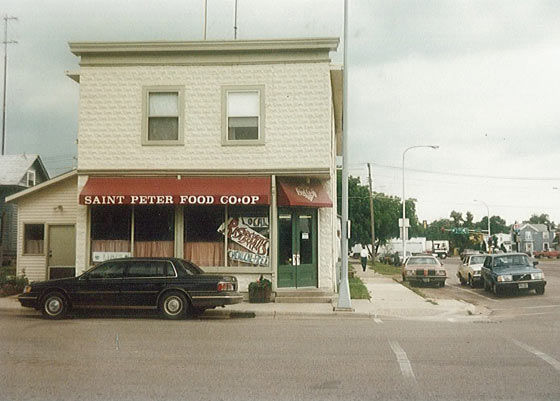
Fast forward to college, the 20-something me re-found his food connection when I stumbled into my local food co-op in St. Peter, MN. A storefront the size of my kitchen, this was the coolest place ever with a countercultural vibe, intermingling a bunch of local La Leche moms and left-wing college kids like myself. I never grew dreadlocks or picketed offices in my radical youth, but I fell in love with the co-op movement as it fit my Midwestern upbringing. It was both radical in spirit and practical in execution. This love affair led me to my two-year farm apprenticeship and four years working for Mississippi Market Co-op in St. Paul upon graduating, rich experiences which truly did make me the organic farm operator I am today.

In the box:

  • Green Peppers
  • Tomato Mix: Man, are these tomatoes slow this year! I had to hunt and peck like crazy to get this little mix of types. 
  • Sweet Corn 
  • Celery
  • Red Onion 
  • Sweet Onion
  • Cuke 
  • Summer Squash 
  • Yellow Potatoes