Disaster Strikes Again!

July 4th typically brings some fanfare…fireworks, that kind of stuff. This year I thought I would just get an interesting show of lightning as I
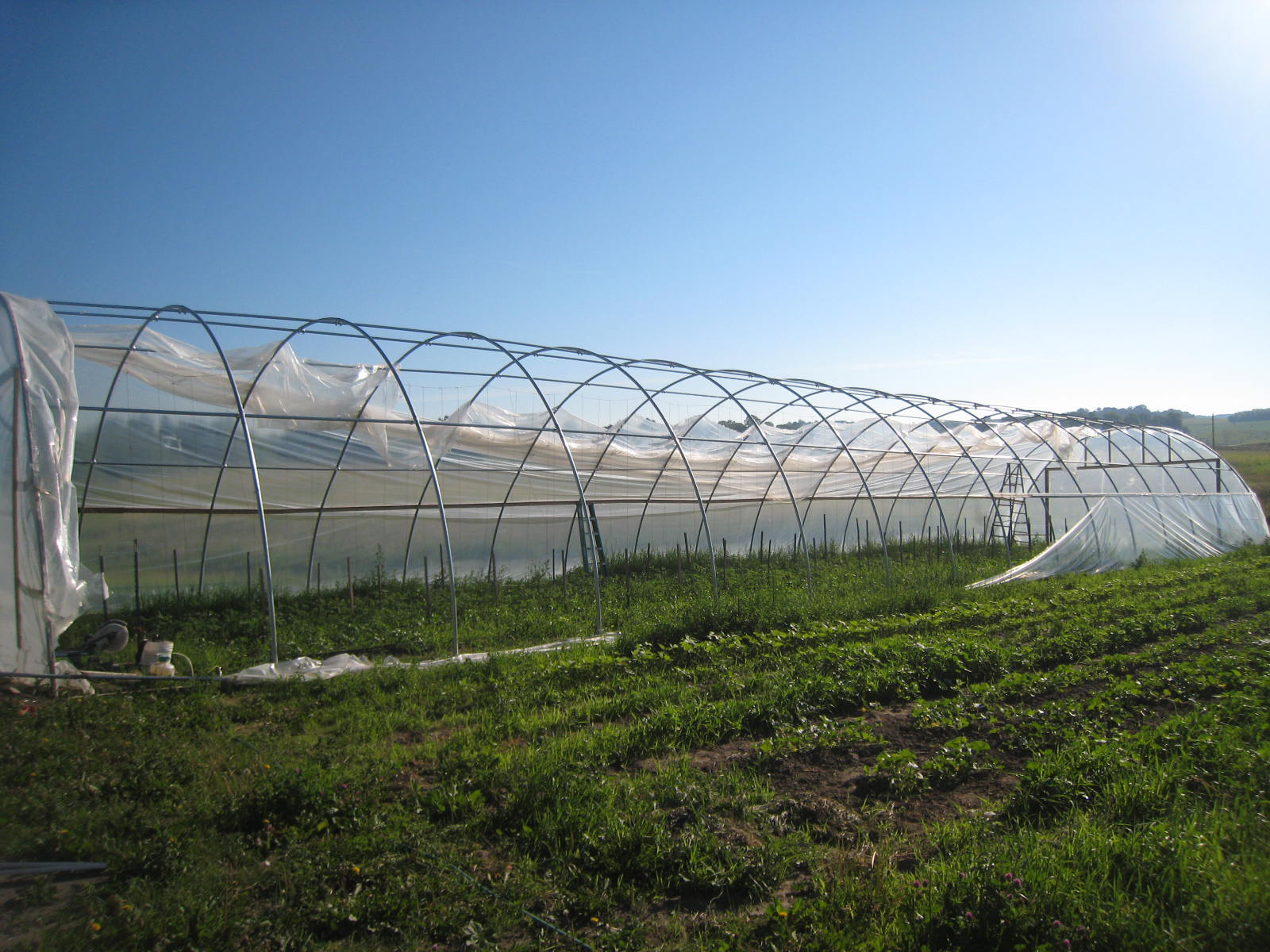
watched the bolts scrawl across the night sky on my driveway. But when I was sleepily moping my way down to feed the chickens just like I do every morning, I had a quite a surprise when I looked past the barn to our high tunnel all torn apart by high winds. This was soon followed by me kicking a couple feed buckets and words I won’t repeat here.

Although not the best development of the season, after I cool down, I always find the positive side.
1. The frame of the high tunnel didn’t get blown away or damaged.
2. No hail. Maree and I thought hail would be a real possibility when the front hit.
3. Generally the crops are looking good this year-that’s what matters. Even the plants in the high tunnel weren’t damaged.

I fully expect I can repair the plastic with greenhouse tape, a strong and clear tape used in situations just like these.

Otherwise the rest of the week was fairly normal. I did spend last night haying our few fields with my neighbors even though I really should have rather been picking peas for the box.  But when bales need to come in, they need to come in.  It’s all ok with me, regardless, since it’s a job I always love doing.  It’s one of the toughest jobs on a farm physically, but a person just feels good getting the bales stacked in the barn and nice and dry.  A person also sleeps really well too.  I told my neighbor Marv that I think anybody who currently needs sleeping pills for a good night’s rest find some baling party they could help out with.

In the box:
Mammoth Melting Snow Peas
Strawberries
Basil
Arugula: The ones that look like little oak leaves.
Packman Broccoli
Napa Cabbage aka Chinese Cabbage: I thought I’d throw in a recipe video (below)…you really can’t go wrong with this by sauteing it.  I like a basic recipe which is only cabbage, sugar, rice vinegar, and cayenne or red pepper flakes.
Green Onions
Red Sails Lettuce
Green Lettuce
Kohlrabi
Zucchini: Hey, first of the year.
Braising Mix (colorful bunch of greens): Some last week, but this stuff is “ready” and wouldn’t last another week.

Chinese/Napa Cabbage Video Recipe:

Posted by Picasa

How Organic is Organic?

At least once a season I like to take a little time to explain our growing practices.  I’m always asked if we’re organic, and I have to explain that the term has become pretty confusing since the national organic standards were put in place by USDA.  Since I’m not certified by an official third-party, I cannot use the term “organic” without being subject to a fine, so I just explain a bunch of details about our practices.  I’ve found eaters are most concerned about individual practices anyway and are not too concerned that I don’t have the official USDA organic logo.

First and foremost we NEVER use any synthetic pesticides, herbicides, or fertilizers.  The only bug we do control is the Colorado Potato Beetle with a natural spray with an active ingredient called Spinosad, which is a bacteria which affects the bug’s nervous system.  This spray is approved under organic certification, which, I know sounds kind of confusing, but there is a family of natural organic pesticides.  Since we don’t have much recourse for bugs, sometimes we will use a physical barriers.  We will put a row cover (kind of like a big dryer sheet) over some greens, for example, that are really susceptible to flea beetles, so the bugs just can’t get at the plants.

For fertility we use good old fashioned manure we procure from our neighbors and manure from our chickens and sheep.  Last year we had nearly 20 loads spread from my neighbor’s dairy herd besides the bedding from last year’s broilers and a good fall cleaning of the barn where the egg layers and sheep hang out.  Corn is a heavy feeder, so we sidedress the young plants with a composed chicken manure in pelletized form.  Also this year we are experimenting with using worm castings on our celery and lettuce, which are both heavy feeders but need a fertilizer which is gentle and safe.  We actually get this from one of our CSA members, Betty and Leroy Fiedler, who just started their worm composting business last year called Genesis on Lake Franklin.

For weeds, it’s a 3 stage process.  We do our best to take out as many as possible by mechanical cultivation with the tractor, next we hoe, and, we always end up pulling weeds by hand.  If a person is really good at timing stage 1 and 2, you never need to get to stage 3, but that hasn’t been the case with us so far.

Bottom line, we raise our stuff as best we can to make sure  the farm and plants are healthy which produces good food which makes your family and our own family healthy.  Let me know if there’s anything you want to know more about.

Important Note: We will have to deliver on Saturday, July 23 instead of Friday, July 22 since I have to be out of town for my other job.  Let me know if this is an issue and we’ll try to work something out.

In the box:
Strawberries: the heavy rains last week did splash dirt a bit on them, so I advise washing.
Kohlrabi
Salad Mix (see recipe below)
Swiss Chard
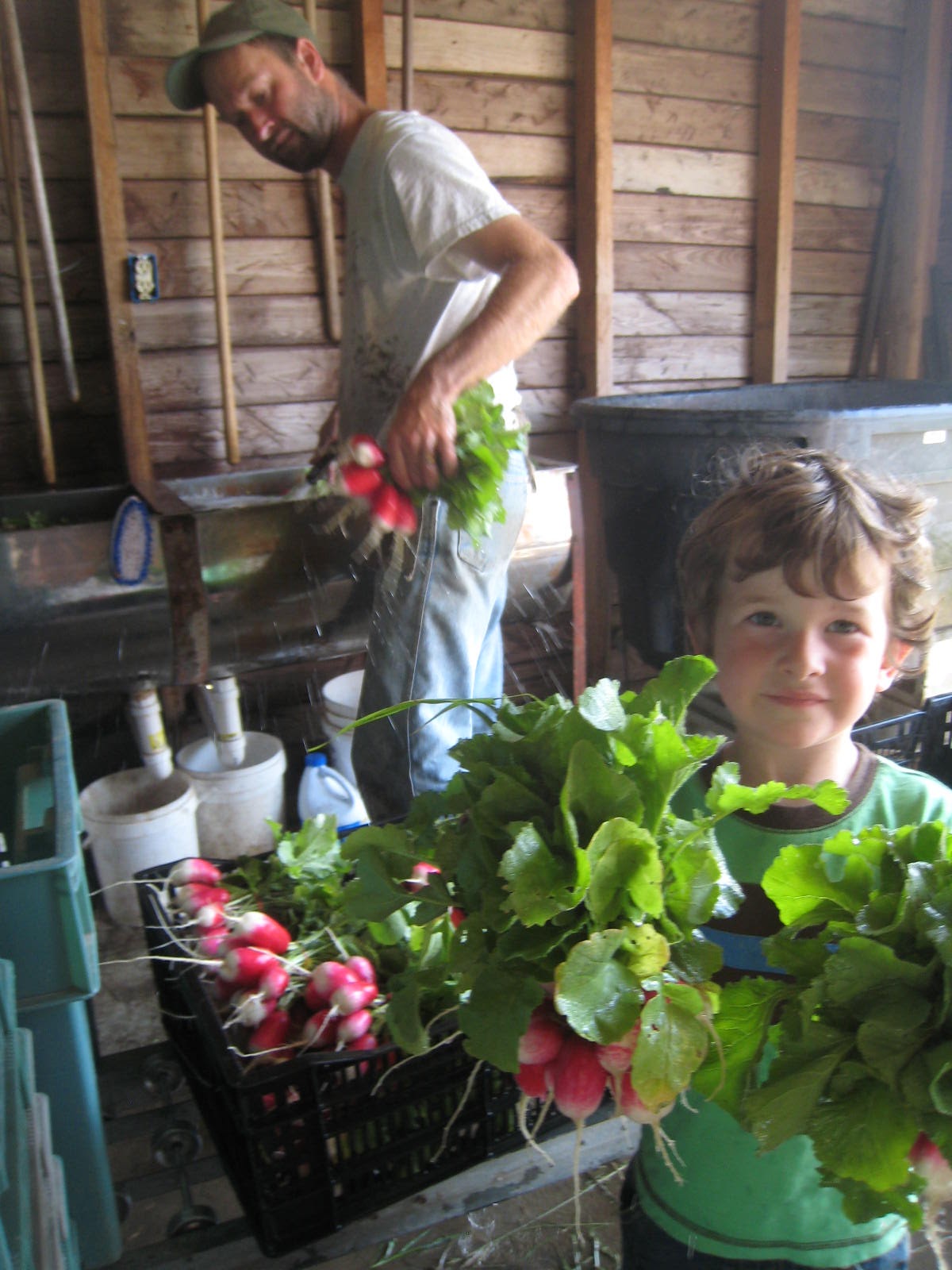
French Breakfast Radishes
Braising Mix (colorful greens) or Green Lance (small broccoli plants): Either are good for adding to a stir fry right at the end.
Spinach
Garlic scapes (funny curly onions): these are shoots that garlic put up this time of year.  Think of them as a garlic-y green onion and use where you would garlic.

Recipe
If you haven’t read Barbara Kingsolver’s book, Animal, Vegetable, Miracle, you may just want to check it out during this CSA season.  It’s a good read with recipes included that may help you out when stumped on how to use something in the box.  Here’s a recipe for this week on using greens: http://www.animalvegetablemiracle.com/EGGS%20IN%20A%20NEST.pdf
This recipe also uses eggs…you are able to add on Lida Farm eggs through Local Dirt as they are available throughout the season!

Start of the Produce Season

I was thinking out in the field this morning that today I’m kind of like a baseball player on the first day of spring training.  I’m excited to start another produce season, but, after a winter without the constant game schedule,  I find I’m a bit out of shape and just not into the swing of it.  I remember harvesting, washing, and packing spinach much quicker than I was able to today.  The hands just didn’t work as quickly as before.  Oh well, after 7 CSA seasons, I don’t panic since I know that it’s a matter of adjustment and the season will get into full swing.

The produce is much the same way.  Since it’s out of practice, the ground can only produce funky cool-season greens this time of year (Mizuna, anyone?).  This makes for the kind of CSA box which could really freak somebody out.  But, I assure you, the garden will get into the swing of the season too and start kicking out a whole mix of veggies without effort.  I know this is true because I’ve seen the signs of summer out on the farm like the first strawberries and blossoms on squash.  A rock-solid season may take some cooperation from the weather, but I’m optimistic.

In the box:
Mizuna – A Japanese green which looks like a bunch of Dandelions.  This is commonly used in a salad mix with lettuce or in a stir fry at the end (see recipe)
Bok Choy – a few received a purple bok choy
French Breakfast Radishes
Spinach
Bunch of Red Russian or Lacinato Kale – You have Lacinato or Dino kale if the leaves of your bunch are dark green.  You have Red Russian kale if your bunch is purple and the leaves are big and jaded.
Mint – small bunch of 4-6 sprigs.  I got into Mojitos this year using fresh mint.  Give it a whirl.
Strawberries (some members) – sorry, I know it’s completely unfair, but we had just a small portion of the strawberry patch ripening, so I had to “play god” with who did and who did not get a pint.

Bok Choy and Mizuna stir fry 
Ryan’s version based on a recipe from Epicurious 
1 bunch mizuna
1-2 bok choy, roughly chopped
2 cloves garlic, minced or pressed
2 T soy sauce
2 t sesame
2 t peanut oil
1 t rice vinegar

Mix the sauce (2 T soy sauce, 1 t rice vinegar, 2 t sesame oil) and set aside.  Add 2 t peanut oil to pan over medium high heat.  Add the bok choy stalks and saute until crisp tender.  Add bok choy leaves and garlic and saute a minute before adding the sauce.  Once the bok choy leaves start to wilt, add the mizuna for 1-2 minutes.  You can serve over rice or rice noodles.  I broiled some teriyaki-merinated pork which I tossed in at the end.

Dead Chickens and a Half Completed Greenhouse

Well, a typical spring season so far. I wish the produce were growing better and further along-another cool spring isn’t helping matters. I’m behind on most things that need to get done and if it’s not one challenge it’s another.

Today’s Challenge
This morning as I sleepily went out to feed the laying hens like normal I noticed big piles of feathers all about the coop. Being the sleuth that I am, I followed the trail out into the pasture where I found not one, not two, but four dead chickens. Argghhh! Whatever came in last night wasn’t even courteous enough to kill off the old laying hens, but went for the young ones now just begging to produce eggs. Don’t these predators
know I’ve got better things to do this time of year than to play security guard to some laying hens?

Typical Incomplete Spring Project

Like most people who farm, I dream up how the spring season will unfold every winter from the warm confines of my home. This winter I was thinking that I would leisurely put up a new 26 by 96 foot high tunnels and have it planted with tomatoes, cucumbers, and pepper by early May.
Hah…three weeks ago we finally finished the frame and it still sits there without any plastic covering (a greenhouse is pretty useless without a covering).
Winter plans never foresee the crazy planting schedule that explodes in my face every spring. It’s a lot of waiting and waiting because of cold, rain, and high winds before trying to plug in as many seeds and plants as possible in a whatever window of time nature gives me. I also have to juggle this with the beginning battle with weeds which erupts in June as well as the first forays of insect mercenaries who try begin their invasion on all fronts. Typical…
Dad and I working on high tunnel in April (note snow on ground!):

Still, it always turns around. The plants will grow. I’ll fight the weeds and bugs. Produce will be harvested and delivered. It’s only a matter of time, but I know we’ll get there.

What Keeps us Busy in the Spring?

Before we start planting outside and really firing up the greenhouse, we try to take care of some items we won’t have time to do when the vegetable season starts in earnest. We take care of jobs related to the sheep like trimming hooves and shearing (I thankfully hired this out this year).
For the last three years we’ve been out sugaring in April, tapping trees and waiting, waiting, waiting for sap to boil down in to syrup. Here’s a picture of Maree and Graham finishing off syrup at the end of the process:

The finished product:

Ever wonder what happens to old laying hens? It’s called canned chicken and broth. The chickens are cut up, put into mason jars, and processed in a pressure canner. The final product is kind of gross looking, but the flavor is great. It’s pretty convenient when you’re making a pot pie or chicken soup and you have pre-cooked chicken on hand. The backs and necks get boiled for broth and then processed in the pressure canner. 4 chickens yielded 14 quarts of broth and 7 quarts of canned chicken: