
Packing Produce (CSA week 3)

Well, things are finally starting to grow. Since it’s been so warm lately, I forget how cold it was earlier in the year, and I wonder why things aren’t ready for harvest. But those days in May and early June make a real differencel on when things are ready. But I’m thankful for the warmth…it allows us to watch those warm-season crops take off and finish off the cold season ones (like the spinich which made it in the box before it “bolted” or went to seed). I’m also thankful for the mild rain we had yesterday instead of the “monster storm” we were supposed to get. I feel that we’ve already had our hail for the year and don’t want another round.
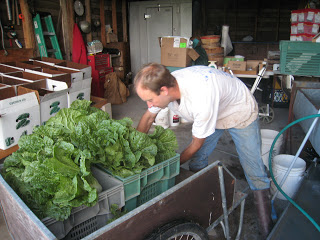
One new development for the year is our new packing shed where we bring in all the produce to be washed and packed in boxes. The shed isn’t exactly new, but we converted our machine shed for the purpose. Up til now, we’ve used the greenhouse, which isn’t optimal for a number of reasons. One being that it’s just a dirt floor and after sloshing around water for a while, I always find myself in a big mud puddle….the heat of the greenhouse didn’t help either!
The set up of the packing shed is pretty important. It’s kind of like a little manufacturing plant…produce comes in, goes through a couple stations and finished CSA boxes go out. I have it set up with all the washing tubs on one side and the tables which hold the boxes on the other. We have a whole bank of tubs and sinks so that we can soak a different crop in each tub for a while, since it’s really important to hydrocool produce for a good half-hour to take out the field heat. If we didn’t do this, the produce would look good when you first get it and then mysteriously go bad in a couple days. In the back is our walk-in cooler–out of the way–where things can be held over for a while. I even just got a set of roollers (kind of like a conveyor belt with rollers) which we’ll be settting up to lessen the time we spend shifting crates of produce around…when the boxes are done, we’ll be able to just count them off and push them down the rollers to the van instead of take two at a time, walking back and forth from the van.
In the box:
Napa Cabbage (see recipe): the recipe is for a cold slaw, but napa is a traditional stir-fry stand by. I like cooked more myself.
Pint o’strawberries
Summer squash (some zucchini and some yellow pattypans)
Kohlrabi
Cilantro (wish I had some tomatoes to go with this!)
Braising Mix: this is a mix of young greens which can be sauteed on their own with some onions or garlic or added a stir fry at the very end. Just chop and fry.
Red Oaklead Lettuce: one of my favorites…it’s pretty and has a nice nutty flavor.
Romaine Lettuce
Spinich

  • 1/4 cup rice vinegar (not seasoned)
  • 2 teaspoons sugar
  • 1 teaspoon grated peeled ginger
  • 2 tablespoons vegetable oil
  • 1 fresh serrano chile, finely chopped, with seeds
  • 1 small head Napa cabbage (1 1/2 pounds), cored and cut crosswise into 1/2-inch slices
  • 1 bunch scallions, sliced
  • 1/2 cup coarsely chopped cilantro


Whisk together vinegar, sugar, ginger, oil, chile, and 1/2 teaspoon salt. Add remaining ingredients and toss well. Let stand, tossing occasionally, 10 minutes.

The Art of Cultivation (CSA week 2)


If you grow organically, you have to learn to cultivate and there’s a lot to it…hence the art. The term is used pretty generally nowadays to mean “grow” or “nurture” things as in “Target has been cultivating customers through their new marketing plan…” Stuff like that. But in farming cultivation means something quite specific: breaking up the ground with a cultivator to kill weeds. I cultivate in a couple of different ways. One is what’s called “blind cultivation”, where you drag a cultivator right over the top of the bed, including the plants. I do this with our new contraption of the year, a Williams Tool System, which is a kind of tine weeder. I always feel like I’m going to kill all the plants, but the tines are designed to put on enough pressure to take out the little weeds, but leave the rooted plants. It has done great work and things like the corn, onions, and potatoes havn’t looked this weed-free before. The other way we cultivate is with a traditional two-row cultivator, which has these shovels and knives on either side of the row to take out anything between the plants.

This sounds pretty straightforward, but a grower needs to keep a fine eye to details to cultivate well, and, frankly, I’m not that great at it. The timing has to be right (best when a lot of weed seeds have germinated, but still just seedlings), the soil moisture good (too wet and you get clods to last the summer), the shanks and shovels have to be digging at the right depth (not too deep, not too shallow), and all the while you have to run the tractor as straight as the rows you planted in the spring or you take out half the row. So far, so good this year.
When I got to thinking about cultivating, it made me think about a conversation I had with my neighbor Marvin last year. Since he’s farmed all his life, I asked him about how many farmers still cultivate and he figured about 5% since life with chemicals is so much easier…instead of cultivating 3-4 times, you can spray twice and kill off every single weed. I thought that was kind of low, but as I was driving around last year I saw only one person other than Marvin and myself cultivating a field! Keep you eye’s peeled…you may still see some out there.
Weather report….hail last saturday, but not terrible. You will probably see some holes in the lettuce, but I promise it will taste the same.
In the box:
Fresh Basil
Kohlrabi: simply peel, cut, and serve…some recipes call for the greens.
Arugula: can mix in with lettuce for salad or find pasta recipe
Red Sails Lettuce
Green Leaf Lettuce
Garlic Scapes: the tops a garlic plant will send up…like a garlicy green onion. Chop fine, sautee a bit, and throw in mashed potatoes.
Quart o’ Strawberries
Some radishes
Red Russian Kale
Kale Colcannon
St. Paul Farmers Market Produce Cookbook
5 med. potatoes, peeled and quartered 1/3 cup lowfat milk
4-6 cups kale, with stems removed, washed and chopped 1 t. salt, or to taste
2 T. butter or margarine 1/8 t. black pepper
1 small onion, chopped
Boil potatoes until tender. Steam kale separately until tender, about 10 minutes. While potatoes and kale are cooking, heat butter or margarine in a large pot. Saute onion until soft. Mash potatoes, add kale, onion, milk, salt, and pepper. Mix well. Reheat and adjust seasonings.
Makes 4-6 servings.

Welcome to Lida Farm…CSA week 1


Welcome to Season 4 of Lida Farm CSA! For some of you, this is something new while others are “old hands” at this point. We’ve been plugging away, working up to this first delivery. A lot like last year, I’ve been nervously looking at the fields, hoping something would grow enough to get into this first box. I can’t say that the last couple of springs have been good to us; the only variation from last year is that it was mostly cold and dry until recently, whereas last year was cold and extremely wet. Either way, a lot of plants have been just sitting there in a holding pattern of sorts.

Typically the Lida Farm Journal includes some news of the farm, a listing of this week’s produce, and a simple recipe which features a veggie or two. But, being that this is the first week of the season, I outline what to expect for the CSA season, so you all know what you’ve gotten yourself into.

1. Boxes: The box gets delivered every Friday, typically late morning to early afternoon. Each week we exchange your box. You set out last week’s empty and we give a new one filled with veggies. The boxes are waxed and get used for 2-3 seasons (this cuts down on all that excess packaging that gets thrown away). We don’t have a lot of extras, so please remember to empty and put out. Please also return green trays and flower vases for flower share.
2. E-mail Newsletter: Up till now we’ve always printed out a paper copy of our newsletter. But, both to cut down on paper and general ease of delivery, we’re moving to an electronic newsletter which will come to your e-mail. When I add something to our blog (http://www.lidafarm.com), you’ll receive an e-mail automatically. Since all news is on our blog, you can also add comments for others to follow…maybe add a recipe of your own.
3. “I’m out of town”: If you are gone some delivery day and will not be around to receive your box, please make arrangements for somebody to pick up at your drop site and put the produce to use. Once we get a route, it’s tough to change it and we really prefer not to make a special drop-off. If not, just give us a call and we’ll work something out.
4. Cooperation: As the name CSA (Community Supported Agriculture) implies, you are buying a share of this year’s harvest as a member of our farm. We will always do our best to supply produce in good quality, quantity, and variety each week, but part of a CSA is that you share in the risk with us. Anything can happen between now and October which may affect supply from a hailstorm to a cucumber beetle infestation which can make the box can get a bit light. We’re all in this together. We share in both the risk and the bounty.
5. Communication: Please contact us with any issues or concerns you may have throughout the season. If you simply need help indentifying a weird green the box or have a concern about the quality of produce or time of delivery, give us a call. We want to make sure things are working for you and would much assume hear about problems sooner rather than later. Maree is typically home during the day and can be reached at 218-342-2619, whereas I’m around evenings and weekends. I’m also available by e-mail at lidafarmer@gmail.com
6. Season’s Schedule: We will run a 16 week season, so the last delivery will be October 9. If there is a change to our schedule, I will notify you through the newsletter.
7. Add-ons: This is something new this year we’re trying after hearing from members and non-members alike. As part of this, we will offering things in addition to the weekly box like cut flowers, organic cheese/butter, eggs, extra produce, and other local foods we can source from other growers. Every other week, you’ll get an e-mail of what’s available and order up what you want. We’ll deliver with your box on Friday. We’re calling it the “Marketbasket” program. Stay tuned for details.

IN THE BOX:
Salad mix: This has been washed once (unlike the bagged mix which does a triple wash), so please soak in some water before spinning again, especially because we’ve had some heavy rains which gets soil on plants.
Collards: The standard southern green. To prepare, chop bacon and onions and brown together in a frying pan. Chop collards and add to pan. Once wilted, add some water and cover for a few minutes.
Deep Purple Green Onions: yes, they’re purple…a little change up from white.
Green Lance: An Asian green which is also known as Chinese kale…tastes much like other veggies in the cabbage family. It’s great added to a stir fry for the last minute or two or fry up until sautéed till wilted as a side.
Bok Choi: See recipe below.
Greenleaf Lettuce
A few Radishes
Eggs: Free-range fed on transitional organic feed.

Honey-Soy Grilled Pork Chops with Crunchy Bok Choy from Everyday Food

Vegetable oil, for grates
1 cup long-grain rice
2 T. rice vinegar
1/4 t. red pepper flakes
salt and ground pepper
2 T. honey
1 t. soy sauce
1 t. finely grated, peeled fresh ginger
4 bone-in pork rib chops (8 to 10 oz. each)
bok choy, halved lengthwise (2-4 heads)
1 T. toasted sesame oil

1. Heat grill to high; lightly oil grates. Cook rice according to package instructions. With a fork, stir in vinegar and red pepper flakes; season with salt. Cover and set aside.
2. Make glaze: Combine honey,soy sauce, and ginger in a small bowl; season with salt and pepper. Gill until opaque throughout, 5 to 7 minutes per side. Brush pork with glaze, and grill 30 seconds more per side. Transfer pork to a plate to rest.
3. In a bowl, drizzle bok choy with sesame oil. Season with salt and pepper and toss to coat. Grill until lightly charred on both sides, 1 to 3 minutes. Transfer to plate with chops. Serve pork and bok choy with rice alongside.

Disaster Strikes!

I haven’t been strong enough until now to write about this episode. A high wind blew the farm stand into our field on May 15, totally trashing the landmark I was once so proud of. As you can see, the kids and Cosmo were out assessing the damage.

I don’t like surprises early in the morning but that’s what I had when I stepped out, looked down the driveway, and didn’t see anything. After all the high winds the night before, in a millisecond I knew exactly what happened. Picture me running across the field yelling “NOOOO!!!” as if rushing to the aid of a fallen comrade.
But fear not, the stand will rise again from the ashes. The original builders, myself and my father-in-law, Don, have already drawn up plans for a better, stronger farm stand which won’t blow away. We still plan on opening in July, hopefully with no more surprises.

Planting Sweet Corn with Holland Transplanter


This video shows our transplater and how we get most of our planting in the ground in the spring. The transplanter makes really light work of many plants…could you imagine planting 1300 tomato plants by hand? With this Holland Transplater you can put all of them in an afternoon.

We got ours from a family by Viroqua Wisconsin where they used to grow a lot of tobacco before the quota buyout. Since tobacco has to be set in the ground as a plant as opposed to a seed and often the farms are small, you’ll find a lot of transplanters in areas where tobacco is grown, but not many up in northern Minnesota. Typically people don’t know what I’m talking about when I use the term transplanter, or, if they do, they often say something like “oh, you mean a tree planter!” I guess.