
Win Some, Lose Some
Eggplant, where have you been? Taken out by a maraudering band of Colorado Potato Beetles.
Farming is a gamble and organic farming even more so. I sometimes like to use the phrase ‘without a safety net’ to describe some kind of risky behavior. When it comes to dealing with pests, growing organically without a whole arsenal of pesticides at one’s disposal is pest management ‘without a safety net’ and sometimes you fall off the wire.
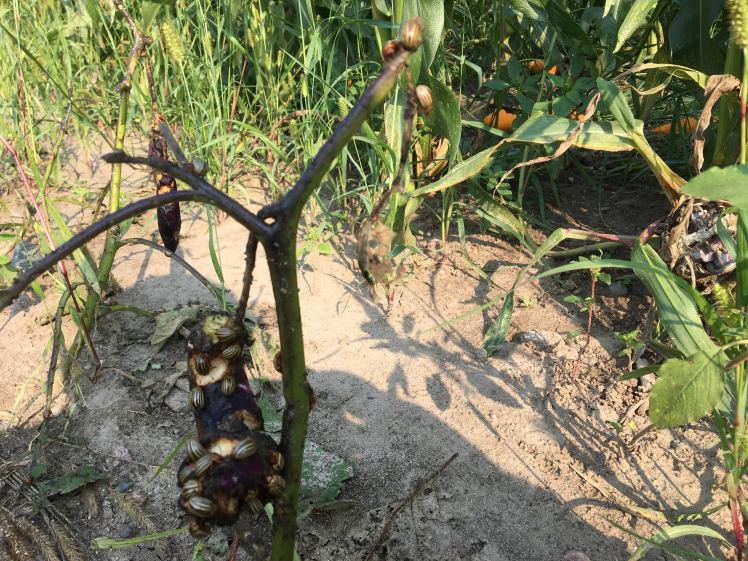 My general attitude after being at this nearly 20 years now is ‘so it goes’ (a la Kurt Vonnegut). Maybe I have a cavalier attitude–especially if you were looking forward to eggplant–but I’ve found there’s a balance to controlling and letting go each season.
We certainly do have control issues. Farming is about us humans asserting some authority over the ground in order to get the Earth to produce the crops we want. Without some control, we’d all be eating the seeds of whatever weeds popped up each year. In many respects, the tools of conventional agriculture are too good and allow a lot of control. Precision agriculture is very real and precise. If you follow this thread long enough, you will find yourself in a future where drones and robots do all the farming and humans are just an ornamental accessory or behind-the-scenes programmers. I’m a romantic and I just hate this vision of the future of farming, but I know this inspires others because of total and precise control that this super-human tech can muster.
In contrast, I think of organic agriculture as art to conventional ag’s science. Humans are part of the system, our feet are on the ground daily. If conventional producers have the outlook of a military general commanding the battlefield, I’d like to think of us organic producers as humble artists painting en plein aire, intuitively drawing a brush across a canvas. Part of painting is what you leave unworked. At times, instead of working harder and pushing harder, you let something go. The crop too far gone in the weeds and the eggplant under attack by a force to great to battle. Fast forward this image into the future and you’ll find a very different landscape, one where people and nature co-exist. Wild and lush landscapes with many small farms tucked within where crop fields and pasture mix, a world healing from the ravages of mankind’s ambitious and industrious hubris. Sorry – that got a little preachy there.
In the box:
- Melons: Mostly watermelons, some cantaloupe
- Yellow ‘Satina’ Potatoes
- Grape Tomatoes
- Roma Tomatoes
- Slicing Tomatoes
- Anaheim Peppers
- Red Bell Peppers
- Fresh Dill
- Leeks
- Onions
- Asian Cukes
- Beet Mix (Red and Gold)
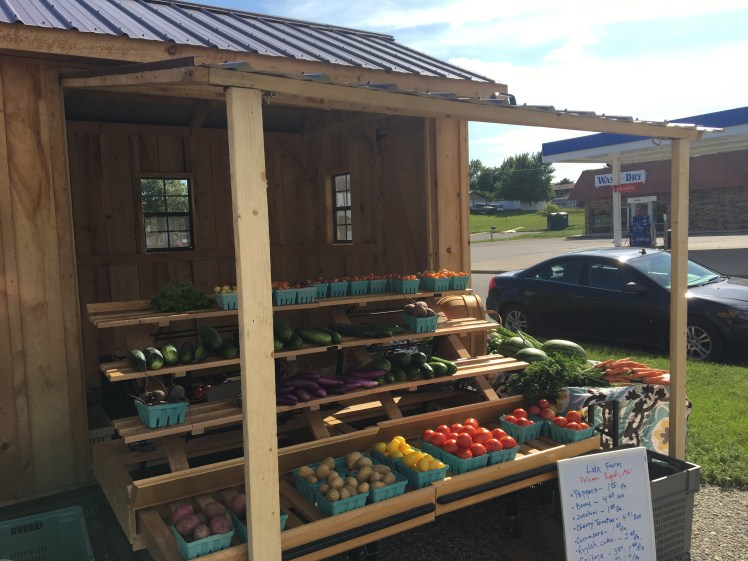 With these experieces as a backdrop, I feel that a shift has occured. When the wholesale supply chain comes to a halt in two weeks, consumers have begun to give their food sources more thought and put a new premium on those sources and food itself. The outcome of this re-thinking is what I’ll call the ‘New Local Normal’ where new people have begun sourcing from local producers and current consumers have doubled-down.
 Well, yesterday was the ‘ripeness check’ day. I approached the patch of vines in which the melons themselves sat indistinguishable, hiding in the camouflage. The watermelons I could see on the edge and were small and immature. No dice. I was bracing for a letdown. Until…pulling back the vines in the center of the bed, I struck gold. My goodness! Talk about melon madness! I went from being worried about getting enough to worried about how I’d lug these things out of the field.
 Whenever you go out with the mower and start to run over items that you had long forgotten were there, you know you have a problem. We use a 6-foot wide flail mower that runs off the PTO on our diesel to mow around the farm. Last week I saw the flail mower shoot up pieces of an onion tray – oops – and only 3 feet later heard the metallic grind of the flails hitting a pile of rocks I had gathered near the cabbage. Small piles of seedling trays are tucked in the weeds all over the place together with buckets, cultivating shovels, watering wands, and more buckets, all of which had a purpose for being there at some point, but that reason is long gone.
 As a whole, the weather variability seems pretty nuts, but it isn’t unusual to have temps go down into the 50’s in August. There is a real benefit of cool nights and sunny days. Ripening. I’ve found that tomatoes ripen really well in these temps. Ripening fruit also does well with little to no rain. I always think of tomatoes as a Mediterranean crop even though they are Native to the New World. As such, I imagine that tomatoes are made for growing in the rolling hills of Italy next to a vineyard, ripening in the aired air.
 Lida Farm