The People Behind the Farm Series: Jane

Although I am pretty much the chief cook and bottle-washer around here, there are many others that play a significant part at Lida Farm that you may not be visible to you. I’m going take some time over the next few weeks to feature each, so you get to know “The People Behind the Farm.”

Our first snapshot is of Jane Solie, our volunteer “apprentice” of the season. Jane has a real interest in sustainable agriculture and came to us this early summer requesting to help out to learn the craft of vegetable production. Jane has been living in Montana the last few years, but is from Detroit Lakes and is in the area for the season. Jane helps us with general production on the farm, aka “weeding” and helps each Friday harvesting, packing boxes, and some deliveries. She will be working on an 0rganic dairy goat farm this fall and winter-in Hawaii of all places! Sounds good to me.
It’s very common for CSA operations like our own to take on apprentices each season. This is how I learned the ropes and it’s also how current growers are training the next generation. I know that without Jane it would be much harder for us to produce a quality box each week.
In the box:
A smattering of bi-color corn
Summer Squash
Alisa Craig Sweet Onions
Garlic
A Couple Green Peppers
Bok Choi
Parsley
Basil
Cherry Tomato Mix
Yellow Taxi Tomatoes
Alcosa Cabbage
Specialty Red Japanese Radish

Hail!

Seems like every year I write at least one “disaster” entry. For this season, our biggest disaster came Tuesday night and Wednesday morning. We had hail, serious rain, and a massive wind. Yes, this definately affects the plants, but, on the good side, this came at a pretty good time (if there is one). This is the time of year when tomatoes are not only small and green, but also hidden under a lot of foliage, so it will leave some pitting, but won’t leave bid open sores on the fruit. If tomatoes were orange, ripening to red, it would be terrible.
Not that there’s no issue with hail.
You will probably notice some holes in the Napa cabbage leaves and maybe some dents. The chicks in the new lean-to also got a bit wet through the whole ordeal too, so I had to carry a few under the heat lamps to get them going again.
FYI: Member workday this Sunday at 2 pm at the farm. This isn’t anything mandatory, but if you’d like to get your hands dirty a bit, see the farm, and pull some weeds, please come. I promise to find something for you to do. We’ll probably go til 4 or 5, so come for what you can.
In the box:
Napa cabbage
Cauliflower (not the best…it’s a bit purple from the heat and sun, otherwise just fine).
Cukes
Summer Squash (the yellow variety called Sunburst and you’d use the same way as Zucchini)
Fennel
Green Beans
Green kale
Bunch of Carrots
Greek Fennel Skillet
(from Simply in Season)
2 cloves garlic (crushed or minced)
In a medium skillet saute in 2T olive oil for 1 minute
2 medium fennel bulbs (the white part of the fennel plant)
1 large onion
Add and saute until tender, 5-10 minutes
1 T lemon juice
3 medium tomatoes (chopped)
Add and cook over medium heat until part of the liquid evaporates, 10 minutes. Salt and pepper to taste.
1 1/2 cups feta cheese (crumbled) or mozzarella cheese
1/2 cup black olives (optional)
Stir in.
Mar and I gave this a try last season and really liked it. We served over crusty Italian bread, although it would work over pasta too.

Weird Produce in a CSA Box

What can I say? I strive to go long on the standard veggies, but what would a CSA be without a little surprise? You know when you open your box and find some real oddball veggie you need a botanical guide to identify.
Members often tell me this is part of what they like about CSA, although too many surprises tends to scare some people away. Still, I think you trying to hit a curveball every now and then is probably good for you…when you get that bulb of fennel in your box here in July, I hope you approach it as an adventure to reach out for that cookbook you never look at and try something new. I’m just as bad as anyone, making those dishes I’ve always done, but it’s good to get out of my rut too.
I was thinking about this today when I was out picking fava beans. I have to confess I’ve never grown these or eaten these in my life, so they are a grand experiment. We had to do a little research to get a general jist to prepare them, especially since you just have a few. A simple way to use your fava beans is to shell them, boil the beans (just a few minutes), remove skin, and toss with olive oil and lemon juice and serve with a sharp cheese like pecorino or parmesan. Otherwise, you’re on your own-good luck!

In the box:

English Peas (the ones you need to shell)
Deep Purple Scallions
Broccoli
Kohlrabi (these could also be added to recipe below)
Parsley
Fresh Mint (stuff that look like a weed)
Fava Beans (big monster beans):
1-2 little cucumbers (just a taste, but the first of the season!)
Black Spanish Onions (see recipe below)
Salad Mix
A bit of Spinach (every week for 4 weeks…are you tired of this yet?)
Raspberries (for some)

RADISH SLAW

This could also be good without the cabbage.

2-3 black Spanish radishes, scrubbed and grated
3 cups finely shredded cabbage
1 cup coarsely grated carrots, any color
1/2 cup thinly sliced green or red onion
2 tablespoons fresh lemon juice
1/2 teaspoon sugar
2 tablespoons olive oil
2 tablespoons finely chopped fresh parsley, cilantro, or mint leaves

In a bowl toss together the radishes, the cabbage, the carrots, the onion, the lemon juice, the sugar, the oil, the herb, and salt and pepper to taste.

Farming in June

June’s a tough month in market gardening.

The guy I used to work for would always say, “If you have a good June, you’ll have a good season.” Sitting here in my 7th season after being an apprentice, I would have to agree.
June and into July is the only time of the year when a grower has all major activities going on at once: cultivating/weeding, planting, and harvesting. It’s a tough balancing act, because, you can get sidelined concentrating on one and do a bad job on another. So, spending too much time on pulling weeds and hoeing and you may just forget about that second planting of beans or putting in cabbage or cauliflower for the fall. Or Thursday rolls around, and, although you have potatoes that need hilling and beets in need of weeding, you have to spend half a day picking strawberries and peas. Yep, it’s a balancing act.
So, Ryan, how was June? Well, plantings are on and harvesting is going well, but those weeds are getting fierce. Good thing we have a long 4th of July weekend to do battle with them.
In the box:
Kohlrabi
Basil
Snap Peas (edible pod)
Red Oakleaf Lettuce
Strawberries
Spinach
Deep Purple Scallions
Some get Raspberries (others are coming in the next couple weeks)
Recipe: Ginger Stir-Fried Snap Peas and Fish Maree is reading this book called the “Art of Eating in” and the author has this website where she’s posting some pretty interesting recipes.

Ducks in the Garden

Growing is all about the unexpected and usually the unexpected is a bad thing.

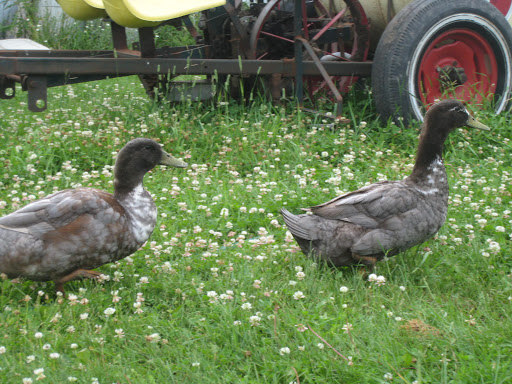
The other day my neighbor told me that my ducks were eating my lettuce and I thought “oh, they’re probably eating that old bed of salad mix…what can they really do?” Well, I found out when I went out there today to find two little ducks had eaten about half of the head lettuce out there and I caught them red handed doing it!
Now I’ve read that ducks are good to have around a place like ours because they are supposed to eat potato bugs, but I’ve yet to see any truth to that. Instead, they are more like farm saboteurs than f’arm helpers.
Honestly, if you or someone you know would like to adopt these ducks, let me know soon. Otherwise their lives will be cut pretty short.

In the box:
Strawberries

Snow Peas
Spinach
Head Lettuce (either green oakleaf, red boston, or romaine)
Radishes (standard cherry belle or french breakfast-the ones which look like bobbers
Braising Mix (bunch with a mix of greens-weird purple one, mustard greens, kale): see recipe below

Spicy Braised Greens from the food network (http://www.foodnetwork.com)

(note: you probably didn’t receive as much as a lb, so adjust accordingly).

Ingredients

  • 3 tablespoons vegetable oil
  • 1/4 pound turkey bacon, diced
  • 1 cup sliced yellow onion
  • 1 tablespoon minced garlic
  • 1 pound collard, mustard, or beet green leaves, or a combination
  • 2 cups water
  • 1/2 teaspoon salt

Directions

Heat a large, 12-inch saute pan over medium-high heat. Add the vegetable oil to the pan, and when hot, add the bacon in the pan and cook, stirring often, until the bacon is well browned, 7 to 8 minutes. Add the onions to the pan and cook, stirring often, until softened, 3 to 4 minutes. Add the garlic and cook for 30 seconds. Add the greens to the pan and cook, stirring frequently, for about 1 minute. Add the water and salt and bring the liquid to a boil. Cover the pan and reduce the heat to medium-low. Cook until the greens are tender, about 20 minutes. Remove the lid, and raise the heat to medium-high, and continue to cook until most of the liquid has reduced, about 5 minutes. Taste and re-season the greens if necessary.