Running on Empty

“Looking out at the road rushing under my wheels
Looking back at the years gone by like so many summer fields”

These Jackson Browne lyrics sting of nostagia, looking back at where we’ve been, and point to how we can only keep trucking forward. I had this song on my old MP3 player years ago and I’d crank it about this time of year in the packing shed to drive my adrenals a bit more as we’d push through from summer into fall. When I heard it the other day, the words ran true. Not just for my state of mind this time of year, but the country as a whole. A lot of people and organizations are running on empty.

Now I’m probably trying to make too much meaning out of a 70’s California Pop song, but I’ve lately noticed the affects of my years of constantly charging forward. In organic agriculture, we talk about feeding the soil and the soil will feed the plant. Looking at some of my fall crops that require good fertility, the plants are hungry. Stunted broccoli and spinach plants. For too many years, I have been racing to button up harvests and start up winter crops and the soil has not been fed with a solid fall manuring and well-timed cover crops. It shows.

Nature gives us signs and the plants outside my house are sharing their advice. Regroup. Dig in. Nurture this little slice of creation for which you were entrusted. Good things will bloom from good care and nourishment. Life is just that simple, despite how often our minds are pulled from our families and communities to affairs far away.

In the box:

  • Cabbage
  • Buttercup Squash
  • Delicata Squash
  • Cucumber
  • A Couple Onions
  • A Few Radishes
  • A Few Peppers
  • Greenleaf Lettuce
  • Carrot Bunch
  • Fingerling or Blue Potatoes

A Night Away

Heaving another 80 lb bin of melons into the back of the van, I was spent. August had turned to September and my back started to hurt thinking about winter squash harvest. Uff-da. Time for a vacation.

So last Friday after working the farm stand at the co-op, Mar and I had a ‘staycation’ in Detroit Lakes, staying overnight at the Lodge and leaving Emily in charge of the farm. It was cool. Mar and I went out for drinks and got takeout from Sapphire. In the morning I sat in a hottub and pretended that I didn’t have a to-do list waiting for me. An hour later, I was back to picking tomatoes.

I usually hammer on the labor movement for Labor Day, but, this year, I’d just like us all to consider how to find moments of rest through this long emergency we find outselves in. Combine 6 months of pandemic fatigue, up and down economy, and, oh my, the election, we all need to find a way to turn off our brains for a night.

In the box:

  • Cantaloupe
  • Red and Yellow Onion
  • Red Potatoes
  • Tomato Mix: End of the line on tomatoes, folks
  • Carrots: Yes, this took forever, I know, but I’m happy we finally pulled them off!
  • Italia Peppers: This long red/green pepper is sweet and good for frying and sauteeing
  • Ancho Pepper: Dark green/red pepper with medium heat.
  • Delicata Squash: Called a sweet potato squash, cut lengthwise, spoon out seeds, and bake upside down on cookie sheet or try some of the ideas in the video below.
  • Fresh Rosemary

Win Some, Lose Some

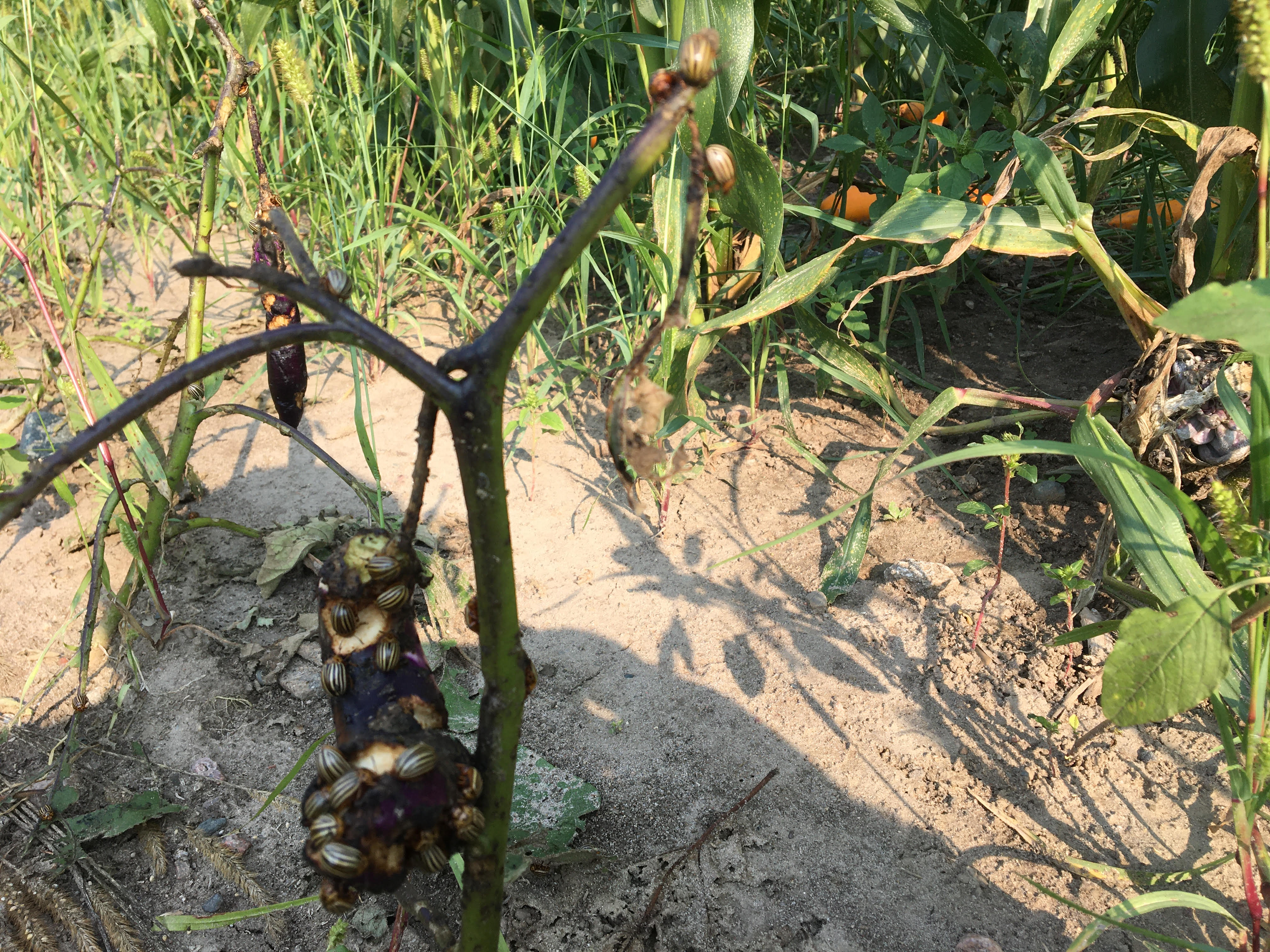
Eggplant, where have you been? Taken out by a maraudering band of Colorado Potato Beetles.

Farming is a gamble and organic farming even more so. I sometimes like to use the phrase ‘without a safety net’ to describe some kind of risky behavior. When it comes to dealing with pests, growing organically without a whole arsenal of pesticides at one’s disposal is pest management ‘without a safety net’ and sometimes you fall off the wire.

potato bugs on eggplantMy general attitude after being at this nearly 20 years now is ‘so it goes’ (a la Kurt Vonnegut). Maybe I have a cavalier attitude–especially if you were looking forward to eggplant–but I’ve found there’s a balance to controlling and letting go each season.
We certainly do have control issues. Farming is about us humans asserting some authority over the ground in order to get the Earth to produce the crops we want. Without some control, we’d all be eating the seeds of whatever weeds popped up each year. In many respects, the tools of conventional agriculture are too good and allow a lot of control. Precision agriculture is very real and precise. If you follow this thread long enough, you will find yourself in a future where drones and robots do all the farming and humans are just an ornamental accessory or behind-the-scenes programmers. I’m a romantic and I just hate this vision of the future of farming, but I know this inspires others because of total and precise control that this super-human tech can muster.

In contrast, I think of organic agriculture as art to conventional ag’s science. Humans are part of the system, our feet are on the ground daily. If conventional producers have the outlook of a military general commanding the battlefield, I’d like to think of us organic producers as humble artists painting en plein aire, intuitively drawing a brush across a canvas. Part of painting is what you leave unworked. At times, instead of working harder and pushing harder, you let something go. The crop too far gone in the weeds and the eggplant under attack by a force to great to battle. Fast forward this image into the future and you’ll find a very different landscape, one where people and nature co-exist. Wild and lush landscapes with many small farms tucked within where crop fields and pasture mix, a world healing from the ravages of mankind’s ambitious and industrious hubris. Sorry – that got a little preachy there. 

In the box:

  • Melons: Mostly watermelons, some cantaloupe
  • Yellow ‘Satina’ Potatoes
  • Grape Tomatoes
  • Roma Tomatoes
  • Slicing Tomatoes
  • Anaheim Peppers
  • Red Bell Peppers
  • Fresh Dill
  • Leeks 
  • Onions
  • Asian Cukes
  • Beet Mix (Red and Gold)

The New Local Normal?

Mid-March and this whole pandemic things seems to come to head. Human psychology fully in play, we begin to stockpile like squirrels readying for winter. First goes toilet paper, then bags of rice, and finally the shelves are quite bare.

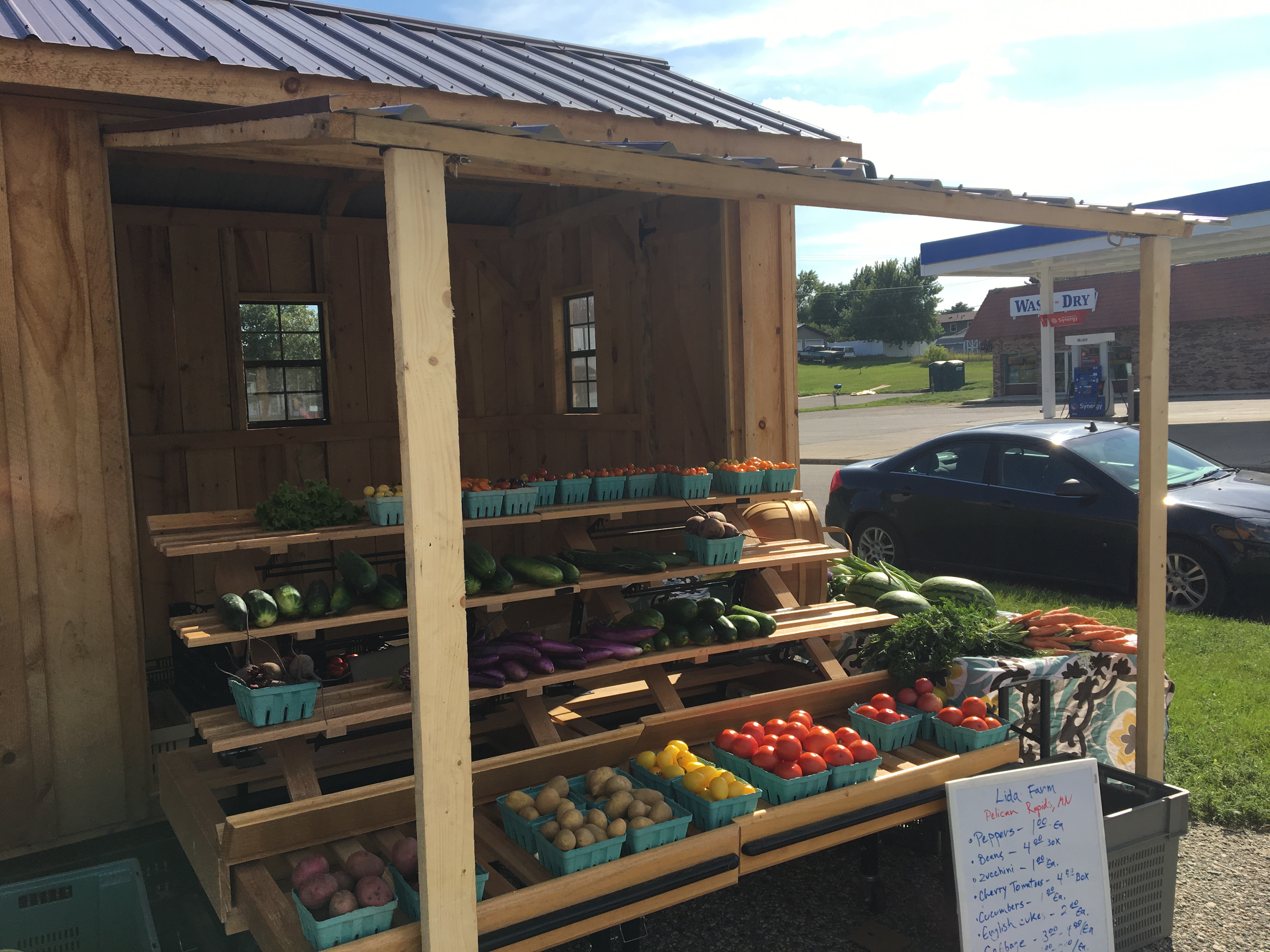
Farm Stand at MannaWith these experieces as a backdrop, I feel that a shift has occured. When the wholesale supply chain comes to a halt in two weeks, consumers have begun to give their food sources more thought and put a new premium on those sources and food itself. The outcome of this re-thinking is what I’ll call the ‘New Local Normal’ where new people have begun sourcing from local producers and current consumers have doubled-down.
I’ve been in a privileged position to witness this change at both MANNA Food Co-op and at Lida Farm from spring to now. We had more than 20 families on a wait list for the CSA in April even though we increased our total number of shares, the co-op nearly doubled its early summer sales from a year ago, and the end of our driveway can get downright crowded as neighbors shop the farm stand. Now this is maybe a function of more eating at home or people looking for a safe place to shop, both of which are true. But, when talking to these families, their stated motivations makes me believe that I’m onto something with New Local Normal. They talk about supporting local producers, putting their dollars in their local community, and just how good it feels to reconnect to food and people near them.

Certainly that last point is the touchstone that I hammer on again and again in a lot of my writings. YES! The very human connection we feel with food is real. The relationship between farmer and eater. Between place and resident. Food and cook. This is stuff of life that grounds us in place from the fresh veggies on the counter to a chat with a neighbor at a farmers market. Small, humble, day-to-day images that together produce a well-rooted life movie in technicolor.

Only speaking for myself, I have felt this connection. These relationships are not just a way that I make money – it’s much more than that – it’s meaningful and heartfelt and important to me. If those new to this scene who are just taking a small step outside of their usual Wal-mart runs catch just a small glimse of this feeling of connection, I’m confident that this New Local Normal will be the start of a local renaissance. Who knows, we may inhabit a future when auctions of shiny glass corporate offices will become old hat while the farms down the street do yet another expansion. Wouldn’t that be a turn of events?

In the box:

  • Sweet Corn
  • Two Melons: Most will receive a cantaloupe and a watermelon, but we’re a bit short on cantaloupe, so some will receive two watermelons.
  • A Couple Leeks
  • Slicing Tomatoes
  • A Green Zebra Tomato
  • ‘Norland’ Red Potatoes
  • Fresh Oregano
  • Fresh Dill: Try the potato salad recipe that features fresh dill video below.
  • Colorful Peppers: These are all sweet onions, none are hot.
  • Small Dino Kale Bunch: Dino Kale is best used in some kind of sautee or soup where you’re cooking down, unlike the curley variety which works well raw as a salad.
  • ‘Suyo Long’ Asian Cucumber: Don’t be scared of this thing…a bit funky looking, but it’s just a cucumber in another shape.

Mystery Melons

Melons are always a surprise for me every year. In early June we take time to lay down a plastic mulch (this is the only crop we use it on), plant, and water in the plants via the drip line under the mulch. In July we may mulch between the rows some and give the plants water, but I mostly ignore melons until mid August when I think ‘I’d better check if the melons are getting ripe.’

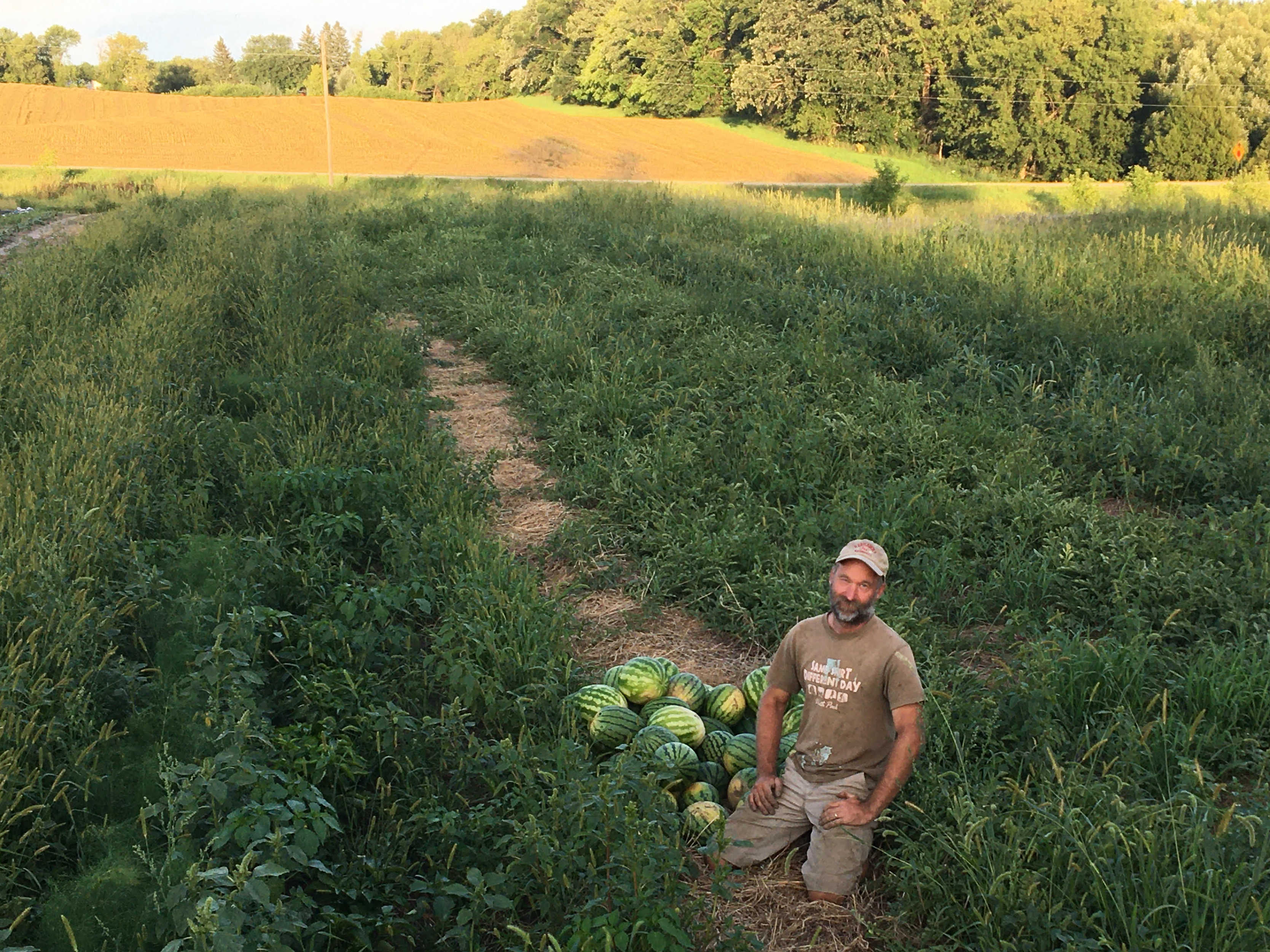
Me and MelonsWell, yesterday was the ‘ripeness check’ day. I approached the patch of vines in which the melons themselves sat indistinguishable, hiding in the camouflage. The watermelons I could see on the edge and were small and immature. No dice. I was bracing for a letdown. Until…pulling back the vines in the center of the bed, I struck gold. My goodness! Talk about melon madness! I went from being worried about getting enough to worried about how I’d lug these things out of the field.

One thing about watermelons especially is how to pick the darn things. Everyone thinks we’re out there knocking on the melons like some inquisitive grandma in the supermarket, but that’s not the secret. There are two indicators – a dried down tendril where the stem meets the vine and a light spot where the melon sits on the ground. If both are present, you’re good. At times, one indicator can be present and still be good, depending on the growing season.  For example, melons with a pronounced spot are very often ripe even if their tendril is still fresh. After cracking a couple open, you get the feel. All told, however, watermelons are a gamble…you can look for a spot in the store, but I say you just have to trust that the grower to find a good one. And letting a watermelon sit around does nothing for ripeness…melons don’t get sweeter off the vine, just softer. 

Whether it’s their hidden ripeness or hiding under vines, melons can be a mystery. And today, when CSA members will receive one of three varieties, the kind you get will also be a mystery! You may find yourself with a pink, yellow, or orange variety, but I’m hoping you find it that sweet taste of the summer nonetheless. 

In the box:

  • Watermelon: One of three varieties – Yellow ‘Sunshine’, Orange ‘New Orchid, or Pink ‘Crimson Sweet’
  • Sweet Corn: Bi-color ‘Allure’ or ‘Montauk’ varieties
  • Red Onions
  • Garlic
  • Red or Yellow Potatoes
  • Summer Squash: Either a green or yellow zucchini. See video below for recipe using fresh thyme, also in box.
  • Slicing Tomatoes
  • Cherry Tomatoes: Luck-of-the-draw. We grow 7 varieties, so maybe Sweet 100’s, Black Cherry, White Cherry, Indego, Artisan, or Nova (an organge grape shaped var)
  • Green Pepper
  • Colored Pepper
  • Fresh Thyme